
A/B Testing for API Services: From Rollout Switches to Trustworthy Experiments
For a long time, my first reaction to A/B testing was frontend work: button colors, landing-page headlines, pricing-card layouts. After building more API services, I gradually found that the harder experiments often live on the backend.
Change a search-ranking strategy. Add a provider to a tool-selection path. Make parameter repair more aggressive. Decide whether a slow downstream API should be degraded earlier. Adjust a cache-hit policy. Any of these can move success rate, latency, cost, and user experience at the same time. Passing in a test environment only proves that the code can run. The real question is whether it performs better under real traffic.
If all you have is a rollout percentage, you do not yet have an A/B test. A rollout reduces blast radius, but it cannot answer whether the new behavior deserves full release. To answer that, you need stable assignment, real exposure, result attribution, metric windows, and guardrails. Without those, the final dashboard may look polished while the conclusion remains unusable.
This article describes the backend experiment pattern I now prefer for API services. It is not a project postmortem, and it does not include private production code. The focus is the reusable engineering shape.
Rollout Is Not Experimentation
Feature flags, gradual rollout, and A/B tests are often placed in the same admin console, but they are not the same thing.
A feature flag controls delivery. The code has been deployed, but the feature is not enabled for everyone yet. That is its most basic value.
A rollout controls risk. You start with 1 percent of traffic, then 5 percent, 20 percent, 50 percent, while watching whether the system can withstand the change.
An A/B test controls judgment. It compares old and new behavior, and the comparison needs to be credible. Credible is doing a lot of work here: the experiment unit cannot drift, assignment cannot be unstable, exposure cannot be missing, results must be attributable, and metrics cannot be changed after the fact.
Unleash’s experiment pattern connects feature flags, variants, and impression data. That is a practical engineering model: the flag delivers the behavior, the variant represents the difference, and the exposure event tells the analysis system who saw what. Statsig’s raw-events documentation makes the same boundary clear: exposure events describe assignment, while custom events describe later behavior. If either side is missing, the result becomes hard to read.
API services have another problem that frontend experiments do not always face: one user action often spans multiple requests. A user searches first, then executes. A task is created first, then polled. A quote is requested first, then confirmed. The experiment may affect the first request, while the outcome only appears in a later request. If the experiment context is not carried across the chain, later success rate and cost cannot be attributed to the correct variant.
Put the Experiment Layer Before Business Logic
A backend experiment system should not be scattered through business code. A more stable shape is to create an experiment context before the request enters the core business logic.
The request enters the experiment layer with user, session, API key, site, environment, region, and other context. The experiment layer does only four things: find the running experiments, decide whether the request matches the target audience, assign it with a stable rule, and return the configuration this request should use. Business logic consumes the configuration. It should not care about the details of assignment.
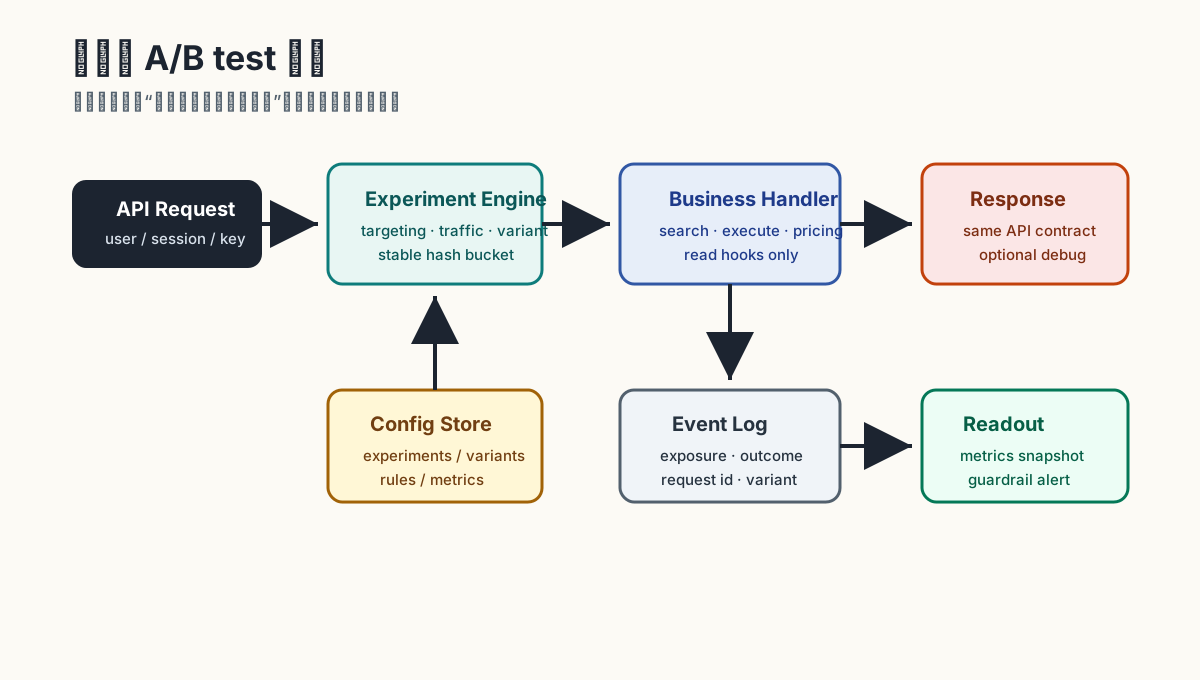
The key is keeping the experiment layer generic. It does not need to know whether the business is search, payment, recommendation, or document processing. It only needs these concepts:
| Concept | Role |
|---|---|
| Experiment | A comparison that can be enabled, paused, and ended |
| Scope | Which service or API family the experiment affects |
| Target audience | Which users, environments, regions, or labels may enter |
| Traffic percentage | How many eligible subjects enter the experiment |
| Variant | Control, treatment, or additional alternatives |
| Configuration snapshot | The exact parameters used by this request |
The business layer should not receive only a string like treatment. It should receive a resolved configuration: use the new ranking strategy, raise the candidate limit slightly, reduce one provider’s weight, shorten the timeout. The configuration can be simple or complex, but the business code should consume it through stable configuration entries instead of checking experiment names everywhere.
This also makes cleanup easier. If the new behavior wins, make it the default and remove the experimental branch. If it loses, remove the entry points. The most dangerous state is an experiment name scattered across business code, two months later, with nobody willing to touch it.
Stable Bucketing Comes First
The easiest place to damage a backend experiment is assignment.
Some systems randomly choose a variant on every request according to a percentage. It looks fair, but it is usually wrong. The same user might see A today and B tomorrow, mixing two experiences into one behavior stream. Worse, later requests may not stay in the same group as earlier requests, which breaks attribution.
A more reliable approach is to define the experiment unit first, then bucket stably around that unit.
For logged-in products, the unit is often user ID. For open APIs, an irreversible digest of the API key is often better. For anonymous short sessions, session ID may be enough. There is no universally correct answer. The right answer depends on what the experiment is trying to compare. If you are comparing user experience, do not use raw request as the unit. If you are comparing call-level strategy, still make sure requests in the same chain do not contradict one another.
Stable bucketing also helps when traffic expands. If you move from 5 percent to 20 percent, the original 5 percent should not suddenly switch groups. The new 15 percent can be added under the same variant weights. This is a small detail, but it prevents many strange metric swings.
If the assignment subject and algorithm are stable, many experiments do not need to persist every assignment. They can compute it on demand. But persistence is still useful in several cases: audit requirements, manual assignment, multi-language systems participating in the same experiment, or an experiment unit that may change. Do not avoid one table if it creates a much larger explanation cost later.
Targeting Should Be Configuration
Backend experiments rarely start with all users. More often, they begin with internal accounts, then staging, then low-risk customers, then core traffic.
That means targeting must be configurable. It should not be hard-coded. At minimum, the system should describe these dimensions:
| Dimension | Typical use |
|---|---|
| Environment | Separate test, staging, and production |
| User or API key | Allowlist, denylist, key customers to exclude |
| User label | Beta users, paid tier, enterprise customers, low-risk sample |
| Region or site | Domestic and international sites, compliance boundaries |
| Time window | Automatic start and end, avoiding long-lived loose experiments |
| Traffic percentage | Gradually expand eligible traffic |
Environment isolation is especially important. If experiment configuration does not include environment, it is easy for someone to enable 100 percent treatment in a test console and accidentally affect production. An experiment system should default conservative, not cross-environment.
Configuration Snapshots Matter More Than Variant Names
Many experiment dashboards record only control and treatment. For API services, that is not enough.
Backend variants are often not a UI block. They are a bundle of parameters: timeout, retry count, candidate limit, ranking strategy, provider weights, cache strategy, fallback order. If you record only the variant name, you will eventually ask: what exactly was inside treatment at that time?
So when a request enters an experiment, record not only experiment and variant names, but also the configuration snapshot used by that request. Configuration may change later, but historical requests must not change with it. Without a snapshot, postmortems become painful.
Configuration should also be consumed through stable business interfaces. The business layer should understand ranking config, timeout config, and fallback config, not a specific experiment name. Experiments and business capabilities should not be tied together permanently.
Cross-request Inheritance Is the Critical Path
As mentioned earlier, API behavior often spans several requests. This is the easiest place to get attribution wrong.
Imagine the first request determines candidate ordering. The second request actually calls one of those candidates. The second request’s success, failure, latency, and price should be attributed to the variant used by the first request. Otherwise you only know that the new strategy made users choose different things, but you do not know whether those choices worked.
My current requirement is simple: whenever the first request is affected by an experiment, write the experiment context into the chain history and keep a short-lived fast cache. Later requests use the chain ID to retrieve the original context. If it cannot be found, degrade gracefully, but record enough data to investigate.
The fast cache is not mainly about reducing database load. It avoids races caused by asynchronous history writes. A user’s second request may arrive immediately after the first request, before the history row is durable. If the second request cannot find the experiment context, attribution is already wrong.
The chain ID might be a search ID, task ID, quote ID, or session ID. The name does not matter. What matters is that the chain can be joined.
Exposure Should Happen at the Intervention Point
When should exposure be counted? This question is harder than it looks.
If a user opens a page but never triggers experiment logic, is that exposure? If the backend reads a flag but the business branch is never reached, is that exposure? If everything counts, the sample will be diluted by requests that never experienced the change.
I prefer recording exposure at the intervention point. A ranking experiment records exposure when the ranking strategy actually takes effect. A timeout experiment records exposure when the timeout is actually used. A provider-selection experiment records exposure when candidate providers actually enter the decision.
An exposure event should answer a few questions: who was assigned to which variant, based on which experiment unit, in which environment, affecting which request chain, and at what time. The “who” should not be a plaintext email, raw token, or raw API key. Use an irreversible stable identifier. Analysis needs joinability, not identity leakage.
Another common mistake is recording only treatment. Control is also part of the experiment. If it belongs to the same design, it needs exposure records too.
Layer Metrics Before Discussing Significance
Before an experiment starts, the most important thing to write down is not traffic percentage. It is metrics.
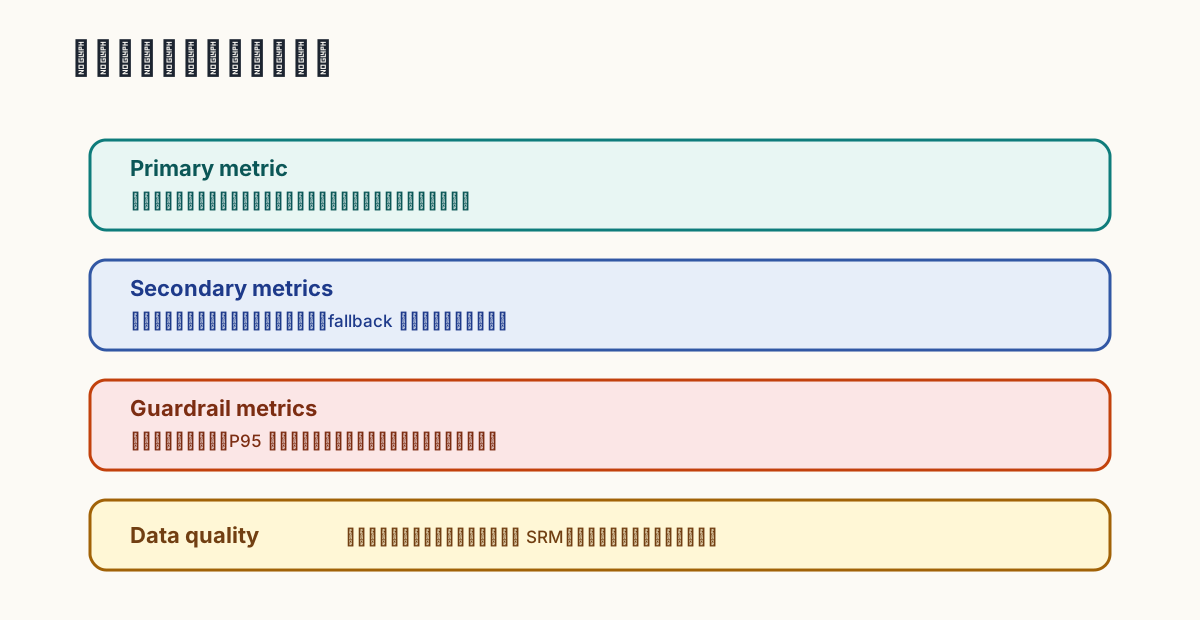
I usually use four layers.
The primary metric decides whether to ship. It should be close to the goal of the change. Ranking experiments may look at task completion or downstream success rate. Execution-strategy experiments may look at effective success rate. Cost experiments may look at effective result per unit cost. Keep the number of primary metrics small, or the team will later choose whichever explanation is convenient.
Diagnostic metrics explain what happened: candidate count, retry count, fallback ratio, provider share, cache hit rate. They do not decide rollout directly, but they explain why the primary metric moved.
Guardrail metrics define the floor: latency, error rate, timeout, cost, complaint rate, throttling, downstream failures. If the primary metric improves while P95 latency or error rate clearly worsens, the experiment should not go straight to full rollout.
Data-quality metrics decide whether the experiment can be trusted. The classic example is SRM, sample ratio mismatch: actual group ratios differ significantly from the designed ratios. Kohavi’s online-experiment material emphasizes this repeatedly. SRM usually means randomization, instrumentation, or filtering is broken. When it appears, do not rush to read business results.
Statsig’s experiment guidance also discusses MDE, the minimum detectable effect. That idea is very useful for backend work. Some technical changes barely move top-line revenue, but they strongly affect nearer process metrics. Instead of waiting forever on a distant top-level metric, choose a primary metric closer to the intervention point, then validate long-term metrics separately.
Monitor in Real Time, Decide With Discipline
Once an experiment starts, everyone wants to keep refreshing the dashboard. Treatment is up in the morning, so you want full rollout. It drops in the afternoon, so you want rollback. That is dangerous. Repeatedly peeking at the primary metric and making decisions on short-term swings turns noise into policy.
That does not mean you should ignore data during the experiment. Health monitoring should be real time. Final interpretation should be disciplined.
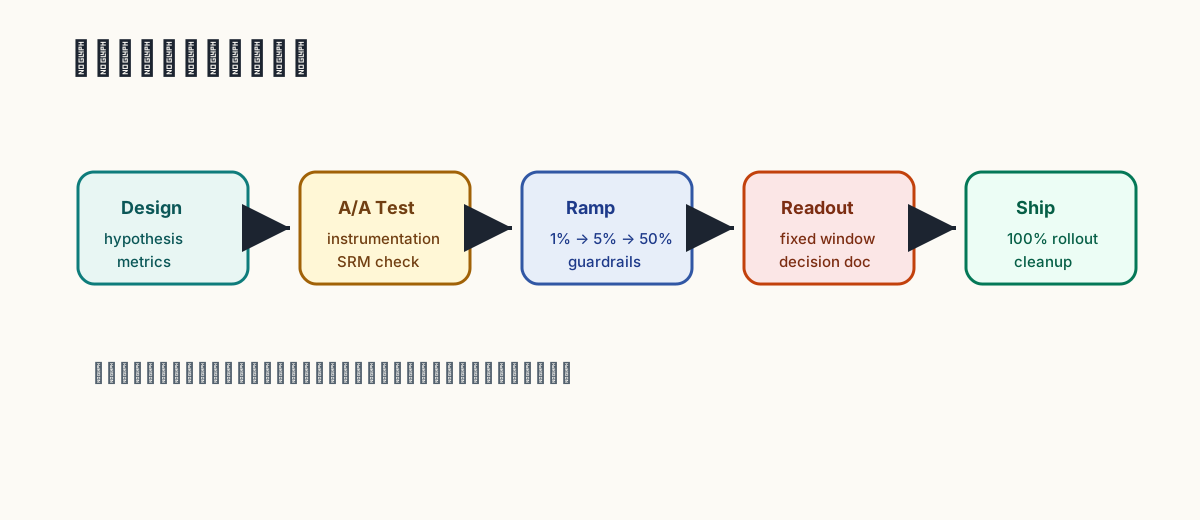
Real-time monitoring is for system health: error rate, P95/P99 latency, cost, exposure volume, SRM, missing logs. Severe degradation can automatically pause or reduce traffic.
Final interpretation is for whether the experiment met its goal. Read the result at the window agreed before the experiment. Do not declare victory early because the curve looks good halfway through. This discipline is boring, but useful.
Automatic shutdown should also be conservative. It is appropriate for system-health metrics. It is not appropriate for short-term business metric noise. Otherwise, the experiment platform becomes a release system allergic to randomness.
If the Experiment System Breaks, the Main Flow Must Not
The experiment layer sits on the request path, so it must be quiet. Configuration loading failure, exposure-write failure, or metric pipeline delay should not make normal business requests fail.
A stable strategy is: if old configuration exists, keep using it; if no configuration exists, do not enter the experiment; exposure-write failure creates an alert, not a request failure; missing cross-request context degrades gracefully and leaves a log trail.
Configuration caching should also be moderate. Too slow, and admin changes take forever to apply. Too fast, and every configuration-service hiccup leaks into request handling. For many API services, a cache in the tens of seconds is enough. Truly high-traffic scenarios can consider precompiled in-memory configuration structures.
A/A Test Is the First Acceptance Test
When building an experiment layer for the first time, run an A/A test first: two groups follow identical logic, and the goal is to validate the experiment system itself.
A/A testing is not ceremony. It catches problems that are otherwise invisible: whether the same user is assigned stably, whether exposure is missing, whether result events can be joined, whether group ratios are normal, and whether segmentation by environment, region, or user tier creates bias.
If A/A does not look flat, do not trust A/B conclusions. Many teams know how to run experiments; they simply trust the ruler too early.
Start Smaller Than You Want
If I were building this from scratch, I would not begin with a full experiment platform. The sequence can be plain.
First, build experiment definitions and stable bucketing for one low-risk API. Then write exposure into request history so it can be joined with later outcomes. Then produce window-level metric snapshots: call volume, success rate, latency, error rate, cost. After those work, add an admin UI, audit logs, automated guardrails, and richer statistics.
The worst path is building a beautiful dashboard first, with sliders, charts, and permissions, only to discover later that exposure cannot be joined to results. The core of an experiment platform is not the page. It is the data chain.
Failure Modes I Check Repeatedly
Request balance is not user balance. If the randomization unit is user, inspect group ratios by user. Heavy users naturally generate more requests.
Control exposure must be recorded. If only the new-feature group is recorded, the control group disappears from the data.
Experiment names should not leak through business code. Business code should consume stable configuration entries. Experiment names belong to the operational layer.
Expired experiments should be cleaned up. If it wins, make it default. If it loses, delete it. Long-lived experimental branches eventually become historical baggage.
Do not look only at averages. API experience is often dominated by tail latency. P95 and P99 are more honest than the mean.
Do not change the primary metric halfway through. You may add diagnostic metrics, but the decision metric and analysis window should be fixed before the experiment starts.
Model-backed APIs Need This Discipline Even More
Many modern APIs now call models or complex strategies behind the scenes. Offline evaluation can filter out obviously bad ideas, but it rarely covers real user inputs, real request chains, and real cost structure.
These experiments must pay special attention to cost and tail latency. A plan with slightly better quality but sharply higher cost may not be worth shipping. A pleasant average latency with unacceptable P99 is still unacceptable. If quality is judged by humans or another model, remember that the evaluator is noisy too. One review pass is not truth.
In the end, A/B testing is not there to make every release look “data driven.” It is a release discipline: start with small traffic, keep the same subject in a stable experience, record exposure only when real intervention happens, join exposure with outcomes, check data quality before reading results, and remove code after the experiment ends.
The new behavior will not always win. But at least the team will know why it shipped, why it rolled back, and which data deserves trust.
References
- Unleash: Implement A/B testing using feature flags
- Statsig: Product experimentation best practices
- Statsig Docs: Raw Events
- Ron Kohavi, Roger Longbotham: Online Controlled Experiments and A/B Testing
- Microsoft Research: Diagnosing Sample Ratio Mismatch in A/B Testing
- Statistical Challenges in Online Controlled Experiments
Follow ZiCode on WeChat
If this post was useful, you can follow later updates on WeChat as well.

X / Twitter
Follow @ax2_zicode
Faster technical notes, short thoughts, and new-post alerts are posted on X.