2013: Weibo Caught The Mobile Internet
I am an old-school programmer. After leaving big tech I have spent my time in startups, and I am still doing hands-on AI-related development. This column will slowly trace the changes in IT from the 1990s to today, with some personal memories mixed in.
I joined Weibo in 2012. By 2013, I more directly felt what mobile internet meant for a platform.
Weibo caught the mobile internet.
That does not mean Weibo did everything right. In later years it would miss many opportunities too. But at least at that moment, Weibo really stood in a good position: phones became the main entry point for information consumption, social relationships made content spread faster, hot events kept users coming back, and celebrities and media provided natural supply.
For engineers, this was not simply a matter of “more App traffic.” It meant backend systems, data platforms, recommendation and distribution, operations analysis, and commercialization all had to adapt to the mobile scene.
Information Followed People
In the PC era, content consumption was often “people go looking for information.”
You opened a website, typed a URL, clicked news, visited forums, and refreshed pages. The information was there; people sat down and went to read it.
The mobile era was more like “information follows people.” Users opened their phones in the subway, at the dinner table, between meetings, or a few minutes before sleep. Hot topics, followed accounts, comments, reposts, private messages, and push notifications came rushing in together.
That made the rhythm of social media faster.
A hot event could emerge and ferment in a very short time. Whether an event was seen no longer depended only on editorial recommendation, but also on relationship-chain reposting, celebrity participation, algorithmic ranking, push strategy, and the user’s current time slice.
Behind that, you needed a data platform.
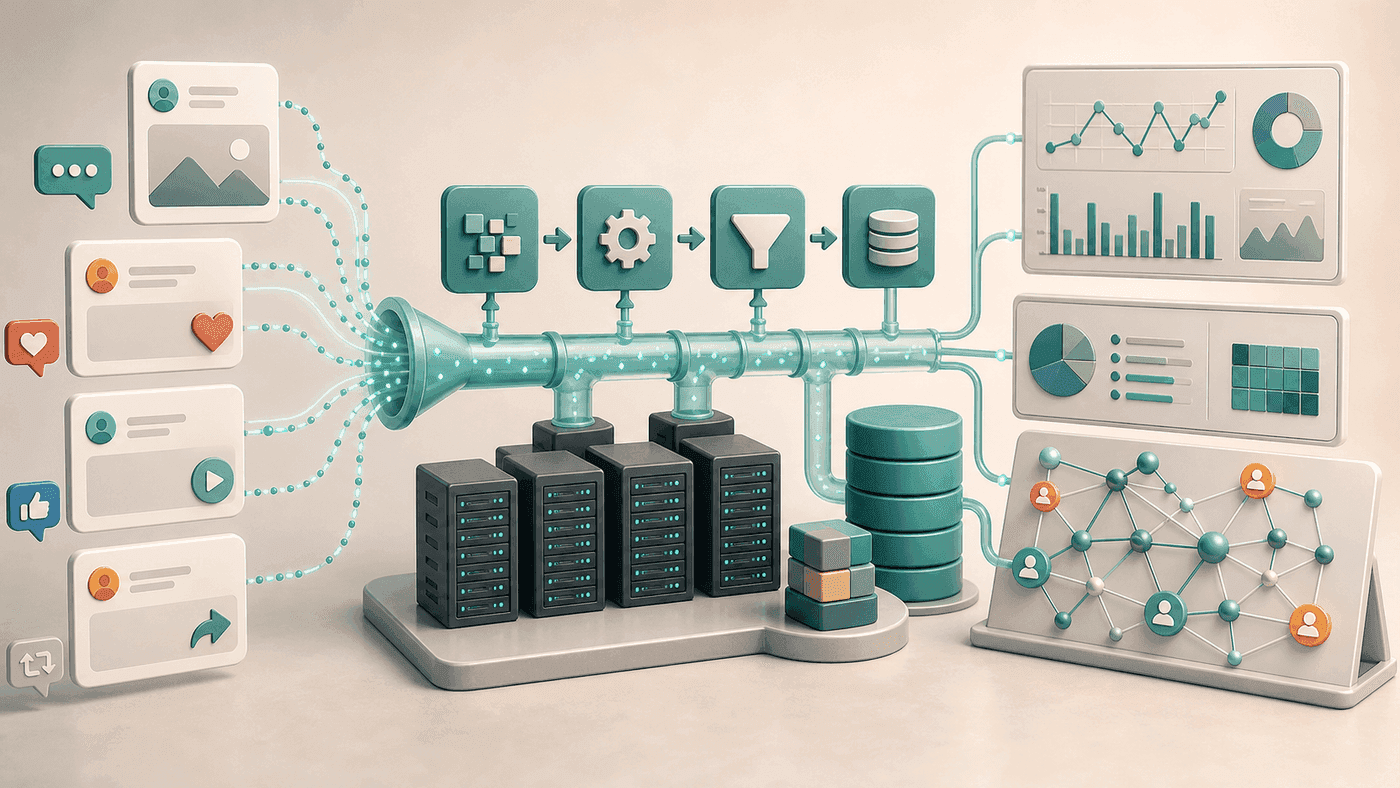
Without data, you do not know which content is spreading, where users are being lost, whether a client version has a problem, or whether a strategy change makes the platform healthier or merely improves a short-term metric.
Big Data Platforms Were Not For Showing Off
I worked on Weibo’s big data platform.
Today the phrase “big data” is no longer fashionable, and may even sound dated. But in 2013 it was key infrastructure for internet companies trying to understand their business.
A social platform produces huge amounts of logs every day: impressions, clicks, reposts, comments, follows, unfollows, dwell time, searches, posts, deletes, reports, and client exceptions. Each behavior is fragmented on its own; together they become meaningful.
The job of a data platform is to turn those fragments into usable information.
That does not mean simply piling logs into HDFS. You must define events, keep collection stable, handle delay and loss, clean dirty data, schedule jobs, provide query interfaces, and make the data usable by product, operations, algorithm, and engineering teams.
The hard part is that a data platform must serve both engineering and business.
If you only pursue technical elegance, the business cannot use it. If you only pursue pretty reports, the underlying quality gets worse and worse. A good data platform should help the company see facts faster, not manufacture more fights over definitions.
Languages And Systems Became Mixed
During the Weibo years, my stack became more mixed.
Java handled platform APIs, Python handled data processing, C handled Redis-related secondary development, PHP handled mobile APIs, and later Go gradually entered daily work. That mixture was not designed; it grew out of the business.
Many startup-like or fast-growing platforms are like this. Each stage leaves its technical choices behind, and later systems pile on top of one another to form real-world complexity.
This gave me a more realistic view of “unifying the tech stack.”
Unification is good, if the company has enough time, resources, and organizational ability to do it. More often, engineers must first keep the complicated system standing, then gradually clarify its boundaries. Delivering stably inside a mixed stack is also an ability.
Seeing The Future Is Not The Same As Capturing It
Weibo did catch the mobile internet in 2013, but it also failed to catch many things later.
That sentence needs to be unfolded in later years. Platform companies often see the future but do not necessarily have the resolve to invest. Seeing that a direction has opportunity and actually committing organizational resources to it are two different things.
Weibo in 2013 was still high up. Social media, mobile entry point, hot-topic propagation, celebrity relationships, and a big data platform were all in its hands. Engineers could easily feel that, as long as the platform kept building, the future would naturally open.
Later I learned that platform competition has no such natural continuation. Every generation of entry point redistributes opportunity. Catching one wave does not mean catching the next.
The next year, Weibo would go public. At the same time, Toutiao was already growing quickly on a different road. Feeds and recommendation would become unavoidable themes in the following years.
IT Events Of 2013
- Mobile internet kept moving the main battlefield. Social media usage accelerated toward phones, making information consumption more real-time, fragmented, and dependent on push, recommendation, and data feedback.
- Weibo expanded its platform influence. Before going public, Weibo continued strengthening hot-topic propagation, celebrity relationships, and mobile usage. Public discussion, media distribution, and commercialization in Chinese social media became clearer in this period.
- Docker appeared publicly. Docker was presented and open sourced at PyCon, and container technology began moving from a tool for a small number of systems engineers toward the center of later cloud-native infrastructure.
- Xiaohongshu was founded. Xiaohongshu started from overseas-shopping sharing and consumer decisions, later growing into a content community, lifestyle platform, and recommendation infrastructure. Consumer content and community trust became more tightly connected.
- Databricks was founded. Databricks grew out of the Spark community and data-processing needs, later becoming an important company in data and AI infrastructure. Data platform commercialization entered a new stage.
- Data platforms became basic internet capability. User behavior, content propagation, relationship chains, and commercialization effects all needed data-platform support. Big data was no longer just backend statistics; it became the foundation for product judgment and strategy iteration.
References
- Weibo Corporation SEC Form F-1: Company history and IPO filing
- CKGSB Knowledge: Miranda Qu and Xiaohongshu
- Docker: 11 Years of Docker
- Databricks: Founders
Follow ZiCode on WeChat
If this post was useful, you can follow later updates on WeChat as well.

X / Twitter
Follow @ax2_zicode
Faster technical notes, short thoughts, and new-post alerts are posted on X.