Project Hail Mary: A Luxury Space Trip Without A Return Ticket
Project Hail Mary: A Luxury Space Trip Without A Return Ticket
Spoiler warning: This review discusses major plot points, character direction, and the ending. If you have not watched the film yet, it is better to come back later.
I went to see Project Hail Mary today. The screening started at 13:00, and the film ran for about 157 minutes. By the time I walked out, my legs were numb.
Let me put the conclusion first: it is not a bad film, but it is not quite a great one either. Scores like 95% on Rotten Tomatoes or 8.5 on Douban feel high to me. Maybe the original novel gives it a strong bonus. Andy Weir’s book is good, and I have read parts of it. The pacing in the novel feels tighter. The film, however, turns a hard-science survival story into something closer to a warm space road movie. It has plenty of gentleness, but not enough urgency.

A One-Way Mission In A Five-Star Spacecraft
The premise is that an alien microorganism called Astrophage is draining the Sun’s energy. Earth faces catastrophe, so humanity builds the Hail Mary mission and sends a crew to Tau Ceti, 12 light-years away, to find a solution. Three people launch. Only one wakes up. The mission is essentially a one-way ticket.
That raises a question: if everyone knows it is almost a suicide mission, why does the spacecraft look so comfortable?
I understand the “unlimited global budget” explanation. But the interior design feels less like a desperate last chance and more like a polished showroom. Equipment is tidy, space is wide, and the lighting is warm enough to feel like a furniture catalog. Compare it with the grimy Nostromo in Alien or the cramped spacecraft in Interstellar. Those feel like places where humans gamble with death. Here, the ship made me feel as if Grace was not going to die, but going on vacation.
Maybe this is a stylistic choice by Phil Lord and Christopher Miller. They come from a lighter, more humorous filmmaking background. But for this subject, when the tone becomes too relaxed, the tension leaks away.
Cross-Species Communication Feels Too Smooth
Grace meets Rocky near Tau Ceti: a spider-like alien from a high-pressure, high-temperature world, also trying to save his own planet from Astrophage. Two species with completely different evolutionary paths should have almost no overlap in language, senses, or thinking.
In the film, they tap pipes, gesture a little, and soon discuss complex science together. I know the novel spends more time on this. Grace is a science teacher, and he builds vocabulary through musical tones step by step. In the book, the process feels like gradual decryption. In the film, it is compressed into a few scenes: they are cautious, then they talk, and suddenly they are best friends.
The difficulty of cross-species communication is softened too much. Once that realism weakens, later cooperation scenes also lose some danger. If talking to an alien is that easy, how dangerous can the crisis be?
The Atmosphere-Sampling Sequence Looks Great
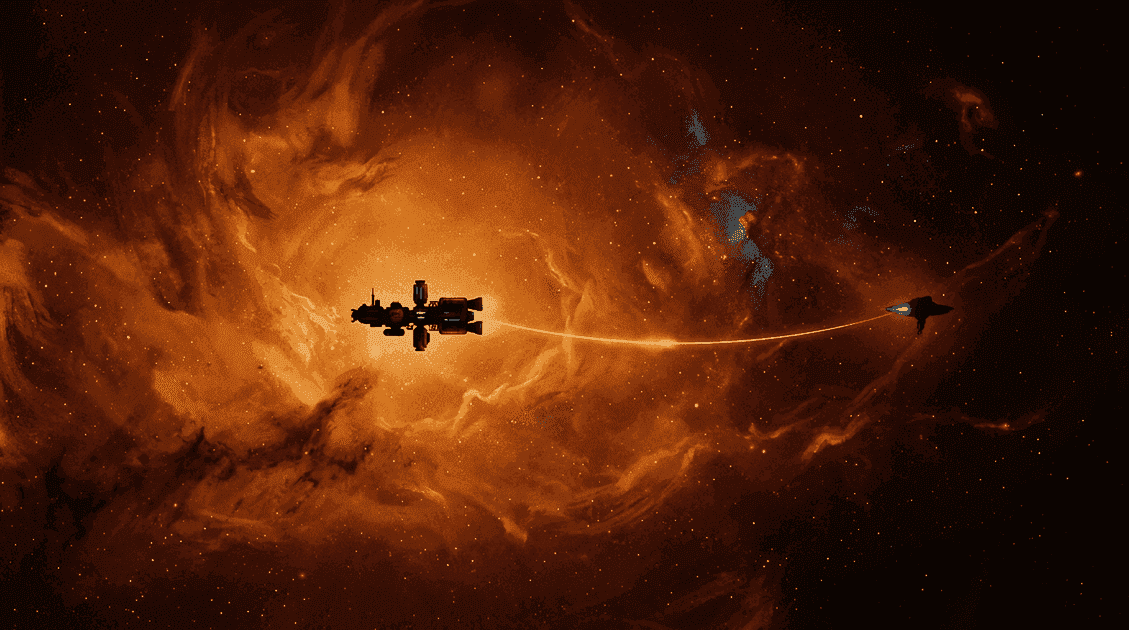
The sequence where the spacecraft dives through a stellar atmosphere to collect Astrophage samples is genuinely impressive. The colors are intense, and the images of entering the star’s chromosphere have impact. The large budget is visible there.
But that is also the problem: it is one of the few big visual moments in the whole film. Much of the remaining runtime is two-character interaction inside the spacecraft. That is not automatically bad. Ryan Gosling and Rocky have some funny chemistry. But for a space science-fiction film with a large production budget, there are too few visual surprises.
Think of the black hole in Interstellar, the debris storm in Gravity, or even the sandstorm in The Martian. Each has several moments that make you sit up. In Project Hail Mary, I felt that only once or twice.
The Forced Boarding Plot Pulled Me Out
Grace is originally a middle-school science teacher. Because of his Astrophage research, he is pulled into the project. Near the launch, he refuses to go. That is understandable. Any normal person would be afraid.
But the film’s handling is simple: Stratt drugs him and puts him into the sleep pod.
I almost laughed in the theater.
If this were a secret mission under a dictatorship, maybe. But the film frames the project as a global, almost United Nations-level effort. You drug a person who has clearly refused the mission and force him onto the spacecraft. What if he refuses to cooperate after waking? What if he breaks down mentally? What if he sabotages the mission?
The novel gives this turn more support through Grace’s moral conflict and Stratt’s ruthless personality. It is extreme, but more readable. The film cuts most of that setup, so “drug him and launch him” becomes a pure plot device.
What Happened To The Other Two Astronauts?
Three people launch. Four years later, only Grace survives. The other two die during hibernation.
How exactly? I honestly did not catch it. The film gives a vague explanation, probably a sleep-system problem, but it passes quickly. This should be a heavy narrative point: your crewmates did not survive, and now you face the mission alone. But the film treats it lightly, so the audience has little time to feel the weight before Grace starts reading manuals and doing experiments.
Some readers say the novel also leaves parts of this unclear, and that it is intentional. I can accept that in prose, because Grace has memory loss and pieces together the truth gradually. But cinema is different. In a film, “not explaining” can easily feel less like ambiguity and more like skipping work.
157 Minutes Is Too Long
Two hours and thirty-seven minutes is long for this kind of science-fiction film.
The first-half Earth flashbacks drag: Grace as a teacher, Stratt finding him, his involvement in the project. These could probably be told in 30 minutes; the film spends closer to 50. In the middle, Grace and Rocky repeatedly try, fail, cooperate, and celebrate. Several emotional beats repeat the same pattern.
The comparison with The Martian is hard to avoid. It is also adapted from Andy Weir, also about a person trying to survive in space, and it runs 144 minutes, 13 minutes shorter. Yet The Martian has stronger information density and pacing. Project Hail Mary feels as if the directors did not want to cut anything.
I noticed someone nearby checking their phone in the last half hour. I understood.
The Music Is Fine, Not Memorable
The score is competent. It supports emotional moments and does not make mistakes, but I cannot recall a theme that stayed with me. It is not like the organ in Interstellar or the synth impact of Blade Runner 2049. It is safe music: correct, but not striking.
The Chinese market ending song by Zhou Shen is pleasant, and his voice suits an ethereal style. But it feels attached to the film from outside, more like a marketing point than part of the movie’s own texture. It is not unpleasant, just not necessary.
Some Good Things
I complained a lot above because I went in with expectations that were not fully met. The film still has real strengths.
Ryan Gosling carries the film. His solo scenes inside the spacecraft, talking to the computer, doing experiments, and making comments, have his usual relaxed humor. His scenes with Rocky are also charming, even if the cross-species friendship is easier to accept emotionally than logically.
The science-fiction details mostly pass. Astrophage, Tau Ceti, and the stellar-atmosphere sampling plan are internally coherent enough. Compared with films that throw around “quantum” and “dimension” as decoration, this one has a baseline of respect for hard science.
Rocky’s visual design works. Five legs, a rocky shell, vibration-based communication: he is not just a person in a suit or a cute mascot. The design has biological logic. Later the film makes him too pet-like, but his first appearance has enough otherness.
Summary
For the cost of a movie ticket and 157 minutes, the return is a fairly enjoyable but not surprising space trip. If you have read the novel, the film visualizes some scenes well. If you have not, you may find the pacing slow, the tension insufficient, and Grace and Rocky’s friendship too easy.
Is it worth watching in a theater? If you are a science-fiction fan, yes. The atmosphere-sampling sequence deserves a large screen. If not, streaming is fine. The film’s main strengths, Gosling’s performance, Rocky’s design, and small humorous beats, will still work on a smaller screen.
Follow ZiCode on WeChat
If this post was useful, you can follow later updates on WeChat as well.

X / Twitter
Follow @ax2_zicode
Faster technical notes, short thoughts, and new-post alerts are posted on X.