
2014: The Shadow Of Toutiao
I am an old-school programmer. After leaving big tech I have spent my time in startups, and I am still doing hands-on AI-related development. This column will slowly trace the changes in IT from the 1990s to today, with some personal memories mixed in.
In 2014, Weibo went public.
That should have been a beautiful milestone. From launch in 2009 to Nasdaq in 2014, the Chinese internet finally had a social media platform large enough to stand on its own.
But for me personally, the deeper memory of 2014 was not the IPO bell. It was the shadow of another name: Toutiao.
Toutiao launched in August 2012. At first it looked like only a news aggregation app, but its real strength was not “news.” It was recommendation. It pushed content consumption one step further, from people looking for content to content finding people.
Weibo saw that direction too.
Weibo Toutiao Was An Early Counterattack
I worked on Weibo Toutiao as the backend lead, responsible for almost all backend work: App APIs, data, recommendation, and related systems.
That sounds broad because the team really was small. At its largest, it had only five or six people. A team that small trying to build a product aligned against Toutiao’s direction carried obvious pressure.
Weibo Toutiao was an S-level company project, and every week we had to report face to face to CEO Gaofei Wang.
That shows company leadership did not fail to see the trend. The problem is that seeing a trend and truly investing resources are two different things. Toutiao treated recommendation feeds as its main battlefield, and the whole company organized around it. Inside Weibo, Weibo Toutiao was important, but it could not monopolize resources.
That determined many later outcomes.
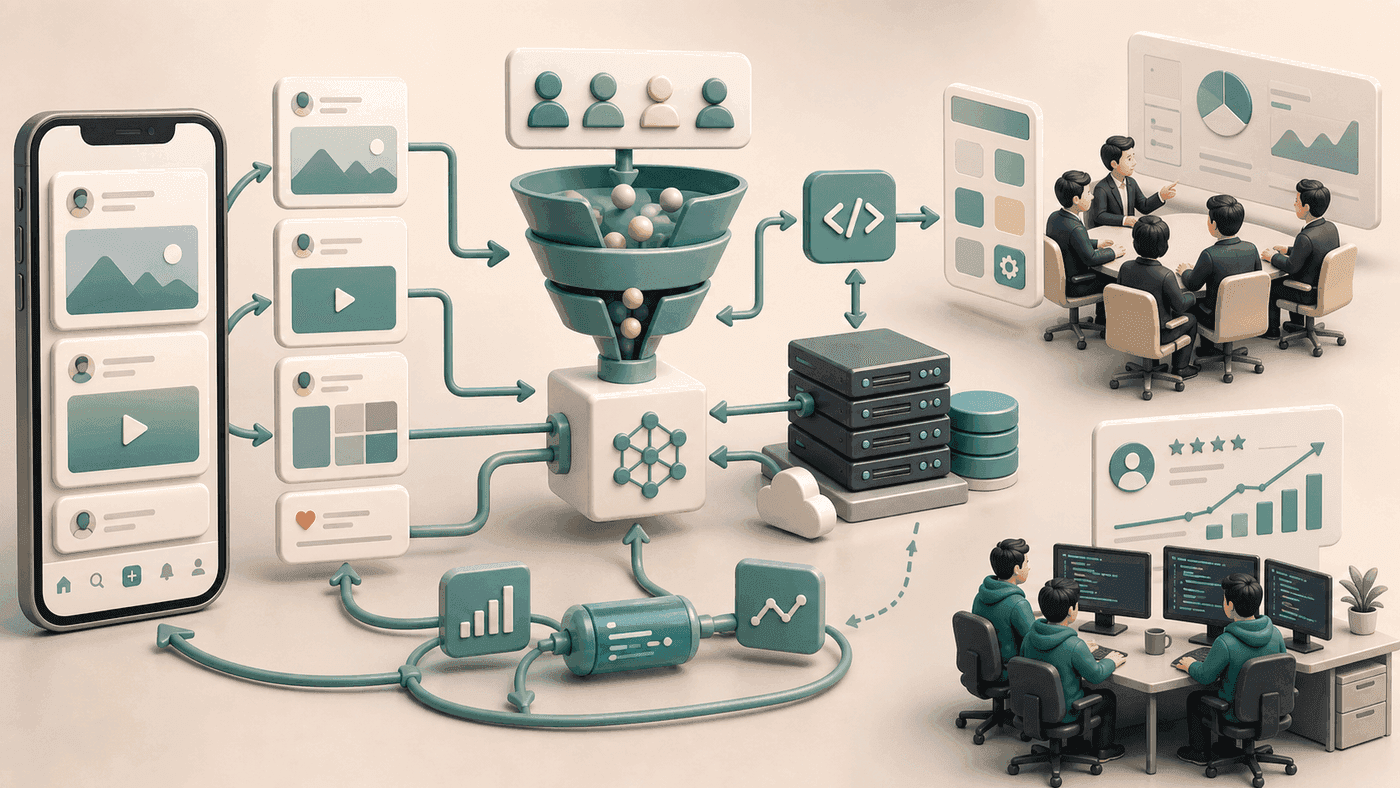
A recommendation system is not a feature point. It is a full set of capabilities: content supply, user profiles, retrieval, ranking, cold start, feedback loops, labeling, review, operations, experiment platforms, data infrastructure, and client experience. If any one link is obviously weak, the whole effect suffers.
Five or six people can build a product prototype, run the pipeline, and iterate on some strategies quickly. But competing with a company that put all its resources behind recommendation was nearly impossible.
Platform-Company Inertia
Weibo had strong assets then: users, relationship chains, hot topics, celebrities, media, and content creators.
Those assets were valuable, but they also created inertia.
A social media platform naturally believes in relationship chains. Users see whom they follow; hot topics are promoted where they happen; celebrities spread what they post. This logic works, and it is precisely why Weibo rose.
Toutiao’s logic was different. It did not require users to first build a complicated relationship graph. It used recommendation to push content directly in front of them.
That was not a product-detail difference. It was a shift in distribution power.
In relationship-chain distribution, users choose part of their sources. In algorithmic recommendation, the platform continuously probes user interest on the user’s behalf. The former is more like a social network; the latter is more like a content machine. Both modes can succeed, but their organizational genes are different.
For Weibo to build a Toutiao-style product, it had to establish a second content-distribution capability outside its existing social media logic. That was very difficult.
What A Small Team Can Do
From an engineering perspective, the most practical thing a small team can do is connect the loop first.
The client must receive content, the backend must organize results, data must flow back, recommendation must update, experiments must compare, and problems must be locatable. These sound plain, but they are the foundation of every recommendation product.
The backend work I owned was wide, from App APIs to data to recommendation. That kind of work trains people because you cannot think from only one module.
Poor API design affects client experience. Slow data feedback affects recommendation iteration. Bad recommendation results affect retention. If the system is unstable, no good strategy can be validated.
That experience made me understand one thing more deeply: many product competitions are ultimately not competitions between individual algorithm formulas, but competitions in the iteration speed of the whole system.
Seeing The Future And Still Losing
Weibo did not fail to see the future.
It saw feeds, saw recommendation, and tried to counterattack. But seeing is not capturing. If a direction does not receive enough resources, organizational priority, and long-term patience, it is hard to truly break through.
This later shaped how I understood platform companies.
Large companies do not miss opportunities because they are stupid. Often there are many smart people and the judgment is not bad. The real difficulty is whether the company is willing to let a new direction challenge the existing main line, keep investing under uncertainty, and accept short-term metrics that may not look pretty.
Weibo Toutiao in 2014 was one answer I personally experienced.
That same year, Apache Spark 1.0 was released. For people working on data platforms, it was a memorable moment: data processing was no longer only Hadoop MapReduce. In-memory computation, interactive analysis, machine learning, and faster iteration became more concrete. Liancheng later researched Spark at Intel’s IoT research institute and contributed to open source, which gave Spark an additional personal memory for me.
The next year, I would keep moving between data platforms and business systems. Big data platforms looked heavy, but the more intense the recommendation and feed competition became, the more necessary they looked.
IT Events Of 2014
- Weibo listed on Nasdaq. In April 2014, Weibo went public. Chinese social media moved from product and community narrative into the capital-market narrative, and the commercialization pressure on mobile social platforms became clearer.
- Kubernetes was open sourced. Google open sourced Kubernetes, and container orchestration began moving from internal large-scale systems experience into the broader cloud-native ecosystem. Later service deployment, elastic scaling, and platform engineering would be deeply influenced by it.
- Docker 1.0 was released. Docker 1.0 moved the container toolchain more clearly from developer experiments toward production use. Images, containers, and deployment consistency became important backend engineering vocabulary.
- Swift was released. Apple released Swift at WWDC, starting a new round of evolution in mobile app development languages. It also showed how platform vendors keep shaping developer ecosystems through languages and toolchains.
- Spark 1.0 was released. Apache Spark 1.0 continued the evolution of the data-processing ecosystem. In-memory computation, interactive analysis, machine learning, and faster iteration became new directions for big data platforms.
- Recommendation-feed competition heated up. Toutiao grew quickly, and recommendation feeds became an important product form in Chinese mobile internet. Platform competition began moving from relationship-chain and editorial distribution toward algorithm-driven content consumption.
References
- Weibo Corporation SEC Form F-1: Company history and IPO filing
- Weibo IR: Weibo Announces Pricing of Initial Public Offering
- ByteDance: Company history
- Kubernetes Blog: 10 Years of Kubernetes
- Red Hat Developer: A practical introduction to Docker containers
- Apple Newsroom: Apple Releases iOS 8 SDK With Over 4,000 New APIs
- Apache Spark: Spark Release 1.0.0
Follow ZiCode on WeChat
If this post was useful, you can follow later updates on WeChat as well.

X / Twitter
Follow @ax2_zicode
Faster technical notes, short thoughts, and new-post alerts are posted on X.