
Quant Trading for Programmers 24: Persist Paper-Trading Account State
Quant Trading for Programmers 24: Persist Paper-Trading Account State
Article 23 linked the daily paper-trading flow. But if the account state disappears after a program restart, that flow is only a demo.
Article 24 first saves and restores the paper-trading account state with a JSON file. It is not the final production storage plan, but it is enough to let the local practice project keep running across days.
Persist Only Base State
Chapter 24 adds app/paper_state_store.py.
It saves only cash and positions. It does not save derived results such as snapshots, daily reports, or recommendation summaries.
The advantage is that after restore, the system can recompute snapshots and risks from the latest market data instead of mistaking old derived state for current state.
Paper-trading state can roughly be split into two categories: base state and derived state. Base state includes cash, position shares, average cost, and realized PnL. Derived state includes market value, weights, risk level, recommendation action, and daily report body. Base state should be persisted. Derived state should usually be recalculated.
Convert To A Dictionary
def paper_account_to_dict(account: PaperAccountState) -> dict[str, Any]:
    return {
        "cash": account.cash,
        "positions": {
            symbol: {
                "symbol": position.symbol,
                "shares": position.shares,
                "avg_cost": position.avg_cost,
                "realized_pnl": position.realized_pnl,
            }
            for symbol, position in sorted(account.positions.items())
        },
    }
The implementation deliberately sorts by symbol so the same account writes stable JSON across multiple saves. That makes diffs and debugging easier.
Save And Restore
save_paper_account(account, "data/paper-account.json")
account = load_paper_account("data/paper-account.json")
The implementation only uses standard-library json and pathlib. When paper-trading state becomes more complex, migrating to a database can happen later.
Current Integrated Run
The paper-ops command saves the account state once in a temporary directory, restores the account from JSON, and then continues running the daily flow:
uv run python -m scripts.chapter_examples paper-ops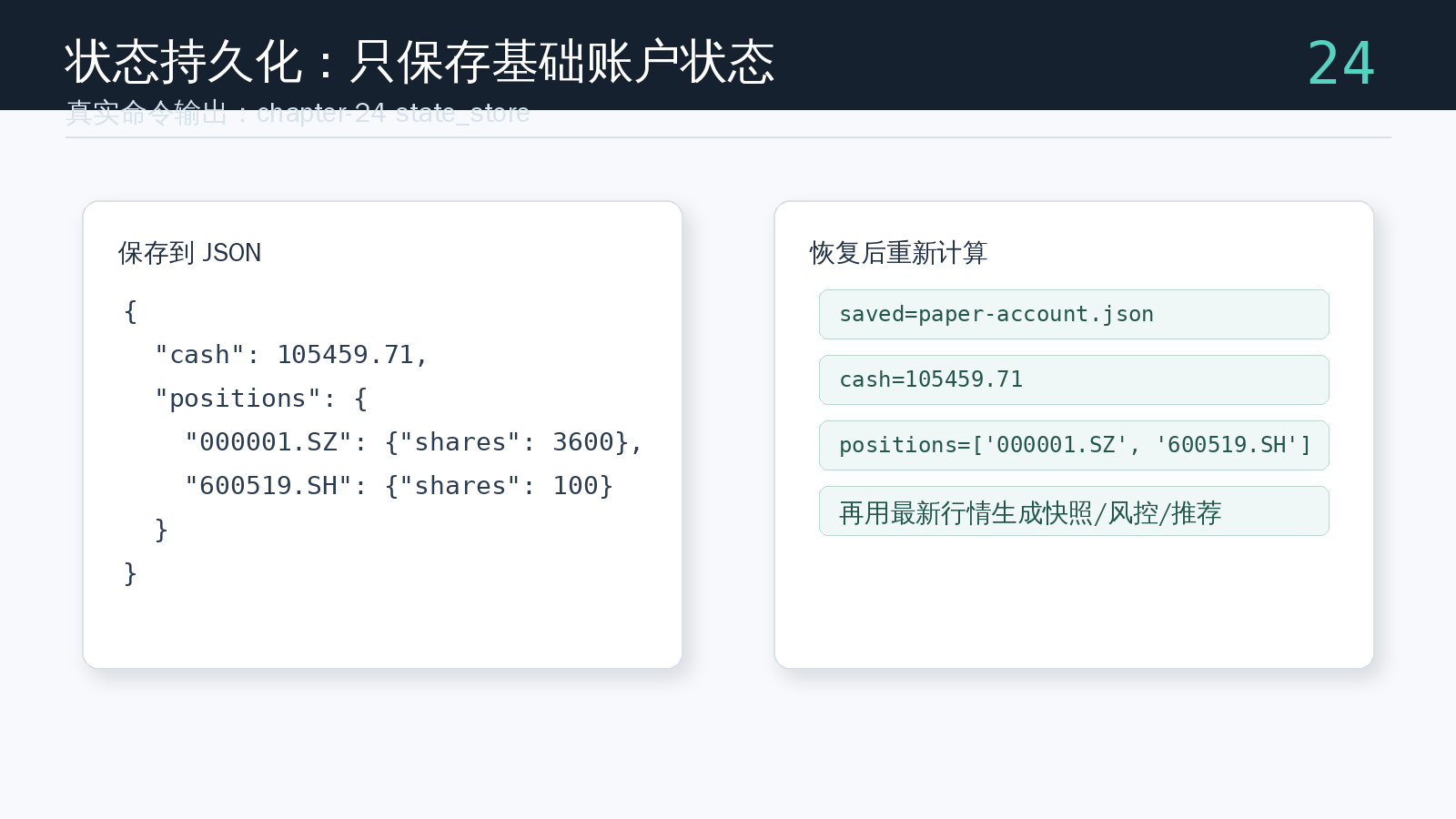
This example intentionally saves only cash and positions. Trade date, latest prices, risk conclusions, and recommendation summaries are not written into the account state file because they should be recalculated as daily market data changes. This also makes it easier to replace JSON with SQLite or PostgreSQL later: the domain object does not need to change with the storage medium.
Chapter Update And Repository
This chapter adds:
app/paper_state_store.py.- Conversion from a paper-trading account to a dictionary.
- JSON file save and restore functions.
- Backward compatibility for old payloads missing
realized_pnl. - An integrated
paper-opsexample showing account state persistence, restore, and continued daily flow execution. - Context for separating base state from derived state in persistence design.
tests/test_paper_state_store.py, covering in-memory round trips, file save/read, and old-format compatibility.
Repository:
https://github.com/ax2/zi-quant-platformCode for this chapter:
git clone https://github.com/ax2/zi-quant-platform.git
cd zi-quant-platform
git checkout chapter-24
uv sync --extra dev
uv run pytest tests/test_paper_state_store.py
Chapter 24 is commit 3c3c52b, tagged as chapter-24.
Summary
Being able to calculate one day does not mean the system can run continuously.
Article 24 lets the paper-trading account state be written to disk and restored. The next article adds production checks so missing prices, target-weight errors, or empty daily reports do not silently enter the daily flow.
Follow ZiCode on WeChat
If this post was useful, you can follow later updates on WeChat as well.

X / Twitter
Follow @ax2_zicode
Faster technical notes, short thoughts, and new-post alerts are posted on X.

More in this column
- Quant Trading for Programmers 28: Abstract Price Inputs Into Price Providers
- Quant Trading for Programmers 27: Record Paper-Trading Daily Reports In Files
- Quant Trading for Programmers 26: Abstract Notification Channels First
- Quant Trading for Programmers 25: Add Production Checks To Paper Trading
- Quant Trading for Programmers 23: Link The Daily Paper-Trading Flow
- Quant Trading for Programmers 22: Save Daily Paper-Trading Review Records
- Quant Trading for Programmers 21: Compress Paper-Trading Results Into A Recommendation Summary
- Quant Trading for Programmers 20: Generate Paper-Trading Daily Reports And Alert Summaries