
Trying GPT-5.6: Strong, but Genuinely Slow
My first impression is simple: GPT-5.6 is slow. Very slow.
I was not asking it to navigate a million-line repository. I gave GPT-5.6 Sol eleven lines of asynchronous Python and asked for a static review. A single run took between 21 and 44 seconds. Once the task expands into research, a Feishu document, image generation, bilingual writing, and a production build, the pauses become hard to ignore.
It is also strong. All four Sol reasoning levels found the intended transaction, locking, blocking-I/O, rollback, and cache-consistency problems. The practical question is not whether it can do the work, but which work is worth the wait.
What GPT-5.6 I Tested
OpenAI introduced the GPT-5.6 family on June 26, 2026. Sol is the flagship tier, Terra balances capability and cost, and Luna targets speed and low cost. As of July 10, GPT-5.6 is rolling out to eligible ChatGPT plans. OpenAI’s current help page says Codex CLI 0.144.0 or newer is required.
My environment was:
Codex CLI: 0.144.1
Default model: gpt-5.6-sol
Default reasoning effort: medium
Date: 2026-07-10
Timezone: Asia/Shanghai
Primary sources:
Four Sol Reasoning Levels
I planted seven review targets in the same eleven-line function: a blocking HTTP call, missing rollback on exceptions, missing cleanup on early return, remote I/O while holding a transaction and row lock, cache mutation before commit, a missing-user path, and unvalidated response JSON.
Each run used the same prompt. Only model_reasoning_effort changed among low, medium, high, and xhigh. I ran the calls sequentially with codex exec --ephemeral --json, measured wall time, and read tokens from turn.completed.usage.
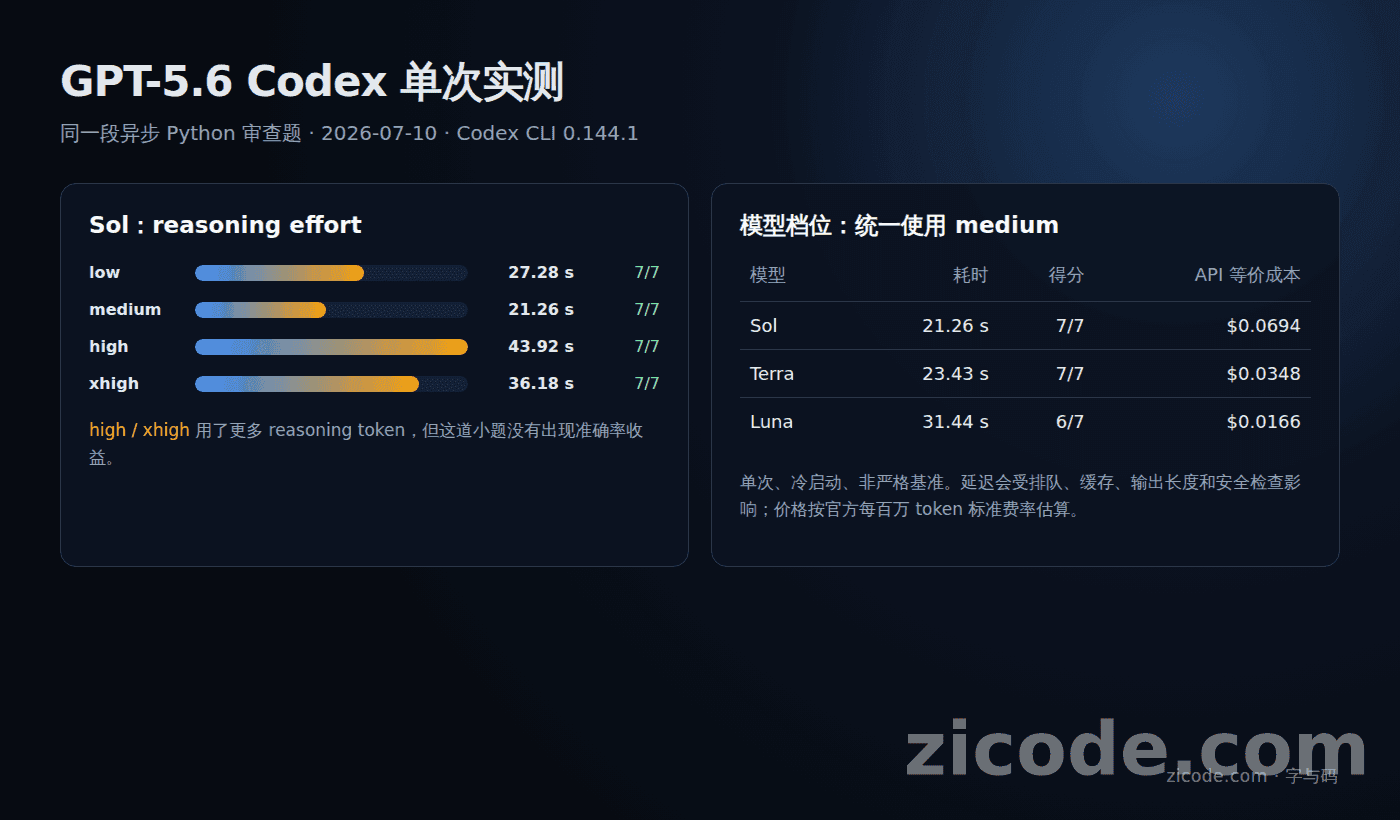
| Effort | Time | Input | Cached input | Output | Reasoning | Score | API-equivalent cost |
|---|---|---|---|---|---|---|---|
| low | 27.28 s | 19,155 | 8,960 | 793 | 331 | 7/7 | $0.0792 |
| medium | 21.26 s | 17,441 | 8,960 | 749 | 268 | 7/7 | $0.0694 |
| high | 43.92 s | 17,416 | 8,960 | 1,260 | 783 | 7/7 | $0.0846 |
| xhigh | 36.18 s | 17,416 | 8,960 | 1,466 | 1,034 | 7/7 | $0.0907 |
The four runs used 75,696 tokens and cost about $0.3239 at standard GPT-5.6 Sol API rates. Reasoning tokens are already included in output tokens and are not charged twice.
Medium happened to be fastest. That does not mean it is universally faster than low: queueing, cache behavior, output length, routing, and additional checks all affect a single request. High and xhigh spent more reasoning tokens without improving the score on this small task. My default for routine review remains medium.
Sol vs. Terra vs. Luna
I then fixed reasoning effort at medium and repeated the same prompt across the model family.
| Model | Time | Score | Input | Cached input | Output | API-equivalent cost |
|---|---|---|---|---|---|---|
| Sol | 21.26 s | 7/7 | 17,441 | 8,960 | 749 | $0.0694 |
| Terra | 23.43 s | 7/7 | 17,416 | 9,472 | 836 | $0.0348 |
| Luna | 31.44 s | 6/7 | 16,225 | 8,960 | 1,406 | $0.0166 |
The standard input/output rates per million tokens are $5/$30 for Sol, $2.50/$15 for Terra, and $1/$6 for Luna. Cached reads cost 10% of the normal input rate.
Luna was not fastest in this one run, and it missed the response-schema validation point. That is not enough data to rank stable throughput. It does show why a cheaper model still needs explicit acceptance checks. Terra preserved the score at roughly half Sol’s cost and looks like the most useful everyday tier from this small sample.
Why The Experience Feels Slow
Token generation is only one part of an agentic task. Codex also reads repository rules, loads skills, fetches sources, invokes browser or app capabilities, generates images, runs tests, builds the site, and returns to uncertain results for verification.
OpenAI’s launch post also introduces a deeper max reasoning effort and an ultra mode that uses subagents. Those were not part of my four-level CLI test and should not be treated as synonyms for xhigh. Product UI labels, API fields, and Codex configuration can differ.
Additional safety checks may also add latency for some biology and cybersecurity requests. My review prompt did not display such a notice, but not every long wait is pure model reasoning.
The Codex Sites Experiment
The Sites test built a “City Weather Lab.” Sites handles the interface and hosting, while the intended server-side route asks QVeris to discover and execute weather, air-quality, and geocoding tools dynamically. It must not hard-code a tool ID or expose QVERIS_API_KEY to the browser.
OpenAI describes Sites as a ChatGPT capability for creating, hosting, refining, and sharing websites. Every deployment URL is a production deployment, and sharing can be limited to the owner, a workspace, or anyone with the link. See the official OpenAI Sites documentation.
What Actually Happened
Sites did not appear in codex plugin list. It was available through a supported Codex App surface instead, rather than as a CLI marketplace plugin with a standalone sites command. After receiving the full prompt, Sites generated the React/TypeScript app and deployed it here:
https://city-weather-lab-qveris.ax2675996.chatgpt.site/
The first anonymous request returned 401 and required a ChatGPT sign-in. After changing access to everyone on the internet, a request with no login and no cookies returned 200 with the complete page. The response still carries X-Robots-Tag: noindex, nofollow, so this is public to anyone who has the link, but it is not intended for search-engine indexing.
Hosting is managed by OpenAI Sites under chatgpt.site, with Cloudflare in front. A Cloudflare edge location identifies where a particular request entered the CDN; it does not reveal the physical location of the origin.
Generation and deployment succeeded, but live QVeris data is not connected yet. Direct requests for Beijing, Singapore, and London all returned 200, while every response reported source.demoMode: true and toolId: demo-weather-current. The current app therefore serves generated demo data, not verified QVeris results. The next step is to configure hosted environment values in Sites, redeploy, and inspect the redacted tool trace.
The current checklist is more concrete:
| Check | Current result | Acceptance criterion |
|---|---|---|
| Sites entry | Available in Codex App, absent from the CLI plugin list | Keep the two surfaces distinct |
| App generation | Complete | React/TypeScript page responds successfully |
| Live URL | Complete | Anonymous request returns 200; access is open to anyone with the link |
| QVeris calls | Incomplete; currently demoMode: true | Query Beijing, Singapore, and London with real, redacted tool traces |
| Credential safety | No key found in the public page or API response | Recheck source, responses, and artifacts after adding the hosted secret |
| Responsive UI | Pending | Clean 1440px and 390px screenshots with no overflow |
| Failure handling | States exist, but live behavior is unverified | Weather, forecast, and AQI fail independently while retaining last good data |
Cost of Producing This Article
I fixed the measurement window from receipt of the request to the first successful full local build: 2026-07-10 12:16:51–12:27:42 (Asia/Shanghai), or 10 minutes 51 seconds of wall time.
| Work | Tokens |
|---|---|
| Main writing thread | 4,005,615 |
| Four Sol reasoning-effort tests | 75,696 |
| Terra medium test | 18,252 |
| Luna medium test | 17,631 |
| Total | 4,117,194 |
The combined workload contained 4,093,319 input tokens, of which 3,792,640 were cached, plus 23,875 output tokens. Reasoning tokens are included in output. Pricing the main thread and four Sol runs at Sol rates, and the two family tests at Terra and Luna rates, produces an API-equivalent cost of about $4.0148.
The dollar amount is an API-equivalent raw token estimate, not a ChatGPT or Codex subscription charge. It excludes third-party tools, image generation, and subscription entitlements.
My Working Default
GPT-5.6 feels more like an engineering collaborator willing to finish a complex chain of work. The cost is waiting.
My current default is therefore straightforward: Terra or Sol medium for everyday work, a higher Sol effort only for genuinely difficult reasoning, Luna for simple batch work, and explicit tests for every polished-looking result.
Follow ZiCode on WeChat
If this post was useful, you can follow later updates on WeChat as well.

X / Twitter
Follow @ax2_zicode
Faster technical notes, short thoughts, and new-post alerts are posted on X.