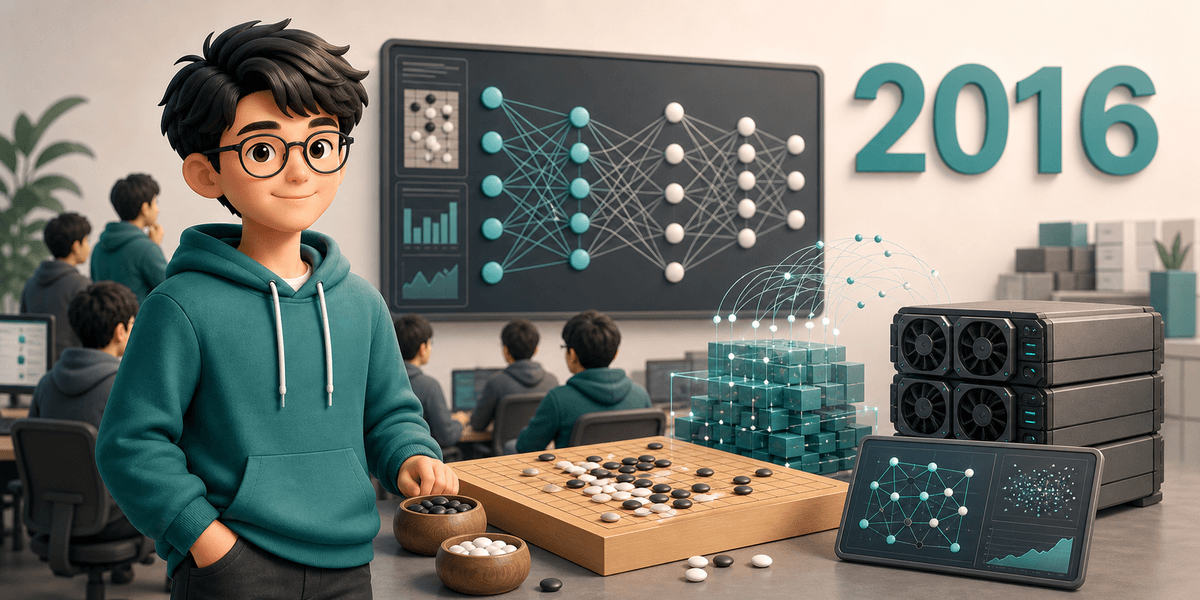
2016: AlphaGo Played A Game For Everyone
I am an old-school programmer. After leaving big tech I have spent my time in startups, and I am still doing hands-on AI-related development. This column will slowly trace the changes in IT from the 1990s to today, with some personal memories mixed in.
In 2016, AlphaGo played five games against Lee Sedol and won 4:1.
It is hard not to write about that.
For many Chinese people, Go is not an ordinary game. It represents complexity, intuition, experience, aesthetics, and for a long time, one of the last pieces of confidence humans held against machines. After chess had been conquered, many people still felt Go was different.
AlphaGo shattered that feeling.
The Machine Won A Game, But It Shocked Imagination
Technically, AlphaGo did not appear out of nowhere.
Neural networks, reinforcement learning, Monte Carlo tree search, GPU computation, large game records, and self-play all had accumulated foundations. But for the public, the real shock was the result: a machine won against a top human player in a field thought to require high intuition.
That moved AI from technical circles into public narrative.
Before that, ordinary people hearing “AI” might think of search, speech recognition, recommendation, image recognition, or even older expert systems. AlphaGo turned AI into a scene everyone could understand: playing Go, and winning.
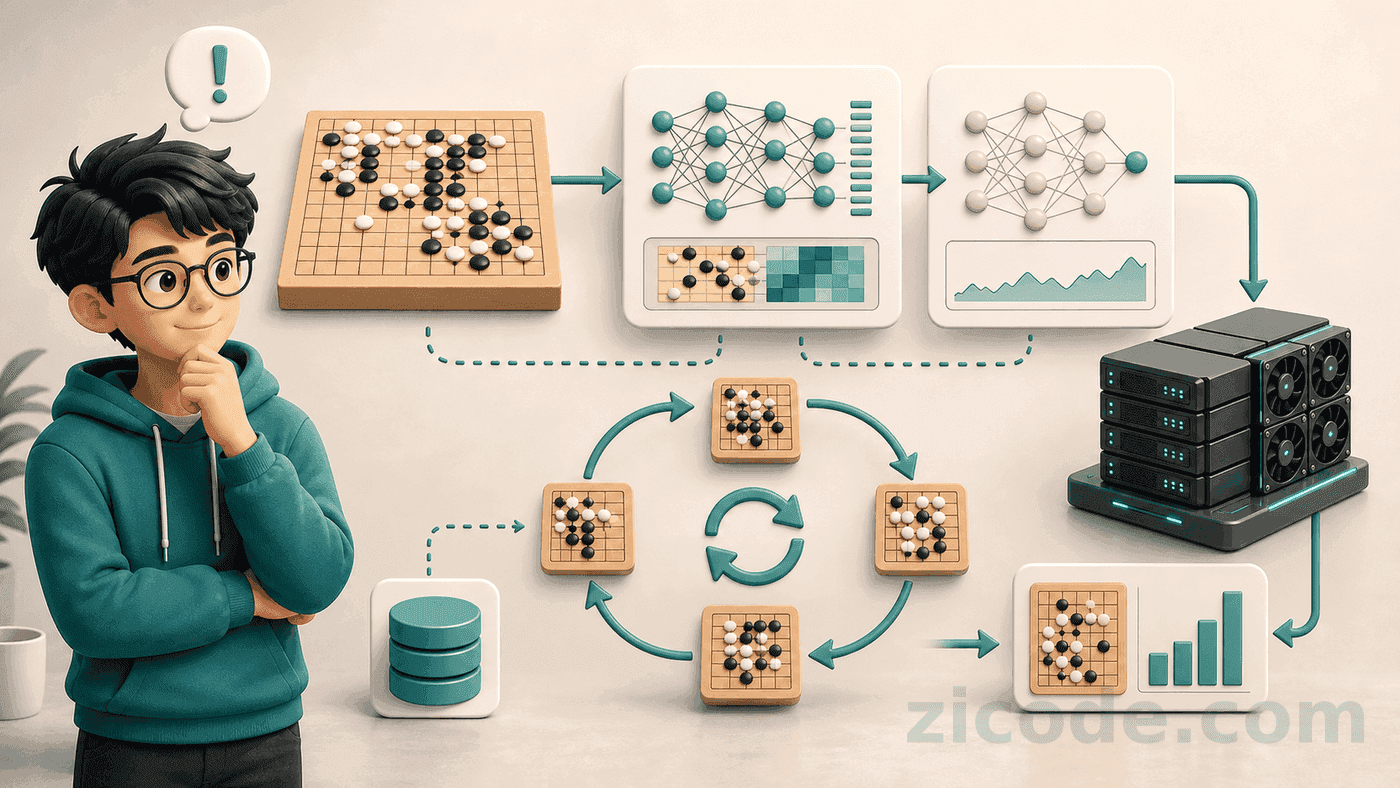
For programmers, the meaning of that match was not only “machines are smarter.” It was more like a signal: once data, models, compute, and engineering organization are combined well, many things once thought to require human experience will be redefined.
Looking At AI From A Data Platform
I was still working in internet platforms and data systems then.
From that position, looking at AlphaGo produced a natural feeling: AI is not an isolated model.
For a model to create value, it needs data, training, evaluation, deployment, monitoring, and feedback. If a model works poorly, the problem may be data quality rather than algorithm. If online performance is poor, the problem may be the engineering pipeline rather than training.
This connects directly to the previous year’s discussion of data platforms.
Without stable data collection, cleaning, storage, and computation, many AI ideas cannot land. Algorithm papers matter, but engineering platforms decide whether they can run in real business.
Later people would talk about MLOps, feature platforms, model serving, online inference, and model monitoring. The roots of those problems were already visible in this period: AI was no longer only a research problem, but also an engineering, product, and organizational problem.
Human Experience Began To Be Re-encoded
The most interesting part of AlphaGo was that it challenged the meaning of “experience.”
In Go, many judgments used to rely on “feel.” That feel is not illogical; it is just hard for humans to state all the logic explicitly. AlphaGo showed that some experience can be re-encoded through data and search.
This has implications for many industries.
Recommendation systems are similar. Editors know what content is good. Senior operators know what users like. Salespeople know what customers may buy. Risk-control experts know what behavior is suspicious. These experiences are valuable, but once data scale becomes large enough, models begin to absorb, extend, and even challenge them.
Humans are not replaced immediately, but their roles change.
They move from “I judge by experience” to “I design goals, understand data, constrain models, explain results, and handle boundary cases.” This is especially obvious for engineers. Writing code is not enough; one also has to understand how data and models change systems.
Large Models Were Still Invisible Then
Of course, 2016 was not today’s large-model era.
People then focused more on deep-learning breakthroughs in vision, speech, recommendation, advertising, games, and autonomous driving. Transformer had not appeared. ChatGPT was still many years away.
But looking back, AlphaGo had already placed several things on the table: compute would become a strategic resource, data would become a core asset, models would become product capability, and AI would move from labs into industry.
Many people did not strongly feel AI changing software until after 2022. My own feeling is that in 2016 you could already hear the sound in the distance, even if it had not yet reached every programmer’s desk.
The next year, my daily work would move more toward Go. Compared with AlphaGo’s grand narrative, Go looked plain: fewer tricks, more engineering efficiency. But very often, the things that truly change work experience are exactly those plain tools.
IT Events Of 2016
- AlphaGo defeated Lee Sedol. In March 2016, AlphaGo defeated Lee Sedol 4:1. AI moved from technical circles into public narrative, and many people felt for the first time that machine learning could challenge fields highly dependent on experience and intuition.
- Deep learning’s influence spread quickly. Vision, speech, recommendation, advertising, games, and autonomous driving all began adopting deep learning more actively. AI was no longer only model research; it became part of products and engineering systems.
- Data, compute, and models worked together. Behind AlphaGo were data, self-play, search, neural networks, and compute. It reminded industry that AI capability comes from models, but also from engineering platforms and training systems.
- Internet platforms relied more on machine learning. Recommendation, advertising, risk control, and content understanding increasingly depended on model capability. Data platforms and algorithm platforms moved closer together.
- AI entered a long industrial narrative. 2016 was not the large-model era, but it made AI a main line of attention for both the public and industry. Later Transformer, GPT, and generative AI would continue unfolding in that narrative.
References
- Google DeepMind: AlphaGo
- Google DeepMind Blog: AlphaGo: The story so far
Follow ZiCode on WeChat
If this post was useful, you can follow later updates on WeChat as well.

X / Twitter
Follow @ax2_zicode
Faster technical notes, short thoughts, and new-post alerts are posted on X.