
Quant Trading for Programmers 29: Generate Target Weights From A Candidate List
Quant Trading for Programmers 29: Generate Target Weights From A Candidate List
Article 19 could already convert target weights into a rebalance plan. But the target weights themselves were still handwritten.
Article 29 adds a plain first policy: generate equal-weight targets from a candidate stock list while controlling gross exposure and the maximum number of symbols.
Why Start With Equal Weight
Equal weight is not the optimal strategy, but it has one advantage: it is easy to explain.
In the early paper-trading stage, the weighting policy should not be more complex than the system itself. First make the chain run end to end with equal weight, then discuss factor weighting, risk budgeting, or industry constraints.
Equal weight is not the only common way to generate weights. Other approaches include weighting by factor scores, inverse volatility, market-cap or turnover constraints, and industry-neutral constraints. They are closer to real strategies, but they also make it easier to hide mistakes inside complicated parameters. Equal weight is a good first baseline because anomalies are easier to locate.
Policy Parameters
Chapter 29 adds app/target_weight_policy.py.
@dataclass(frozen=True)
class TargetWeightPolicy:
    max_symbols: int = 5
    gross_exposure: float = 0.8
    min_weight: float = 0.01
These three fields control the maximum number of stocks, the gross exposure cap, and the minimum single-stock weight.
Generate Equal-Weight Targets
targets = build_equal_weight_targets(
    ["000001.SZ", "600000.SH"],
    TargetWeightPolicy(max_symbols=2, gross_exposure=0.6),
)
The result is 30% per stock. The function deduplicates symbols, filters empty symbols, and truncates the list by the maximum symbol count.
Normalize Weights
Another common input is an external strategy that already produced weights, but whose total exceeds the allowed cap.
normalize_target_weights() drops invalid weights and compresses the total weight into max_total.
Current Integrated Run
In article 29, the paper-notify command uses the policy to convert candidate stocks into target weights:
uv run python -m scripts.chapter_examples paper-notify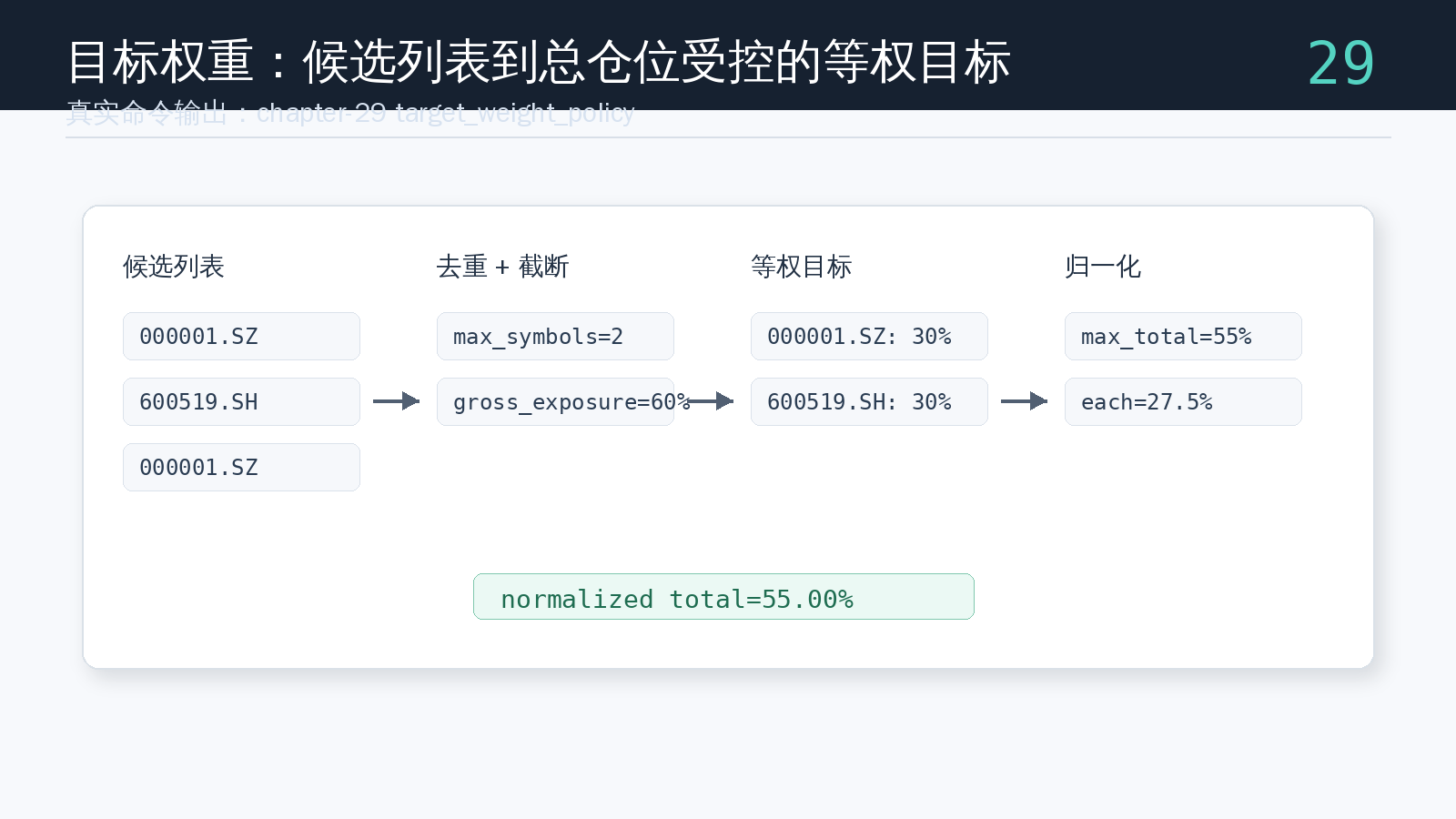
The example candidate list contains a duplicated 000001.SZ. The policy deduplicates first, then generates two stocks at 30% each with gross_exposure=60%. Finally, max_total=55% compresses the total exposure to 55%, giving each stock 27.5%.
Chapter Update And Repository
This chapter adds:
app/target_weight_policy.py.- An equal-weight target-weight policy.
- Constraints for maximum symbols, gross exposure, and minimum weight.
- Target-weight normalization.
- An integrated
paper-notifyexample showing candidate deduplication, equal-weight generation, and gross-exposure normalization. - Background on equal weighting, factor weighting, volatility weighting, and other common weighting policies.
tests/test_target_weight_policy.py, covering deduplication, truncation, tiny weights, and normalization.
Repository:
https://github.com/ax2/zi-quant-platformCode for this chapter:
git clone https://github.com/ax2/zi-quant-platform.git
cd zi-quant-platform
git checkout chapter-29
uv sync --extra dev
uv run pytest tests/test_target_weight_policy.py
Chapter 29 is commit f71baeb, tagged as chapter-29.
Summary
The target-weight policy should stay simple at first.
Article 29 converts a candidate list into explainable equal-weight targets, giving the rebalance plan a more stable input. The next article summarizes prices, production checks, and notification receipts into a run health report.
Follow ZiCode on WeChat
If this post was useful, you can follow later updates on WeChat as well.

X / Twitter
Follow @ax2_zicode
Faster technical notes, short thoughts, and new-post alerts are posted on X.

More in this column
- Quant Trading for Programmers 33: Summarize Paper-Trading Run History
- Quant Trading for Programmers 32: Archive Daily Run Results As JSON
- Quant Trading for Programmers 31: Add A Run Window To Daily Jobs
- Quant Trading for Programmers 30: Generate A Daily Run Health Report
- Quant Trading for Programmers 28: Abstract Price Inputs Into Price Providers
- Quant Trading for Programmers 27: Record Paper-Trading Daily Reports In Files
- Quant Trading for Programmers 26: Abstract Notification Channels First
- Quant Trading for Programmers 25: Add Production Checks To Paper Trading