Quant Trading for Programmers 38: Index Daily Report Archives
Quant Trading for Programmers 38: Index Daily Report Archives
Article 32 already wrote daily-run results into JSON. Article 33 added a simple historical summary.
Article 38 fills in a small tool between them: indexing the archive directory. Later, whether we build a CLI list, a page list, or a manual debugging view, the caller should not rewrite glob and JSON-reading logic every time.
What An Index Entry Contains
The daily report index does not need to copy the full report. It keeps only the fields a list page really needs.
| Field | Meaning |
|---|---|
trade_date | Trading day |
status | Health status for the day |
path | Archive file path |
The full report still lives in the JSON file and is read only when details are needed.
Index Object
Article 38 adds app/report_index.py.
@dataclass(frozen=True)
class ReportIndexEntry:
    trade_date: str
    status: str
    path: Path
This object can later feed a command-line table directly, or a simple web page.
Scan The Archive Directory
The implementation reuses the reader from article 32.
for path in sorted(Path(directory).glob("*-paper-report.json")):
    payload = read_archived_report(path)
    entries.append(
        ReportIndexEntry(
            trade_date=payload["trade_date"],
            status=payload["health"]["status"],
            path=path,
        )
    )
Sorting is based on file name. The archive file name starts with the trading date, so this order is stable and intuitive.
Get The Latest Report
When the index is empty, the helper returns None instead of forcing callers to handle index errors.
def latest_report_entry(entries: tuple[ReportIndexEntry, ...]) -> ReportIndexEntry | None:
    if not entries:
        return None
    return entries[-1]
Small functions like this look trivial, but they remove many repeated checks in production code.
Runnable Example
paper-run-plan writes three days of daily report archives into a temporary directory, then builds an index:
uv run python -m scripts.chapter_examples paper-run-plan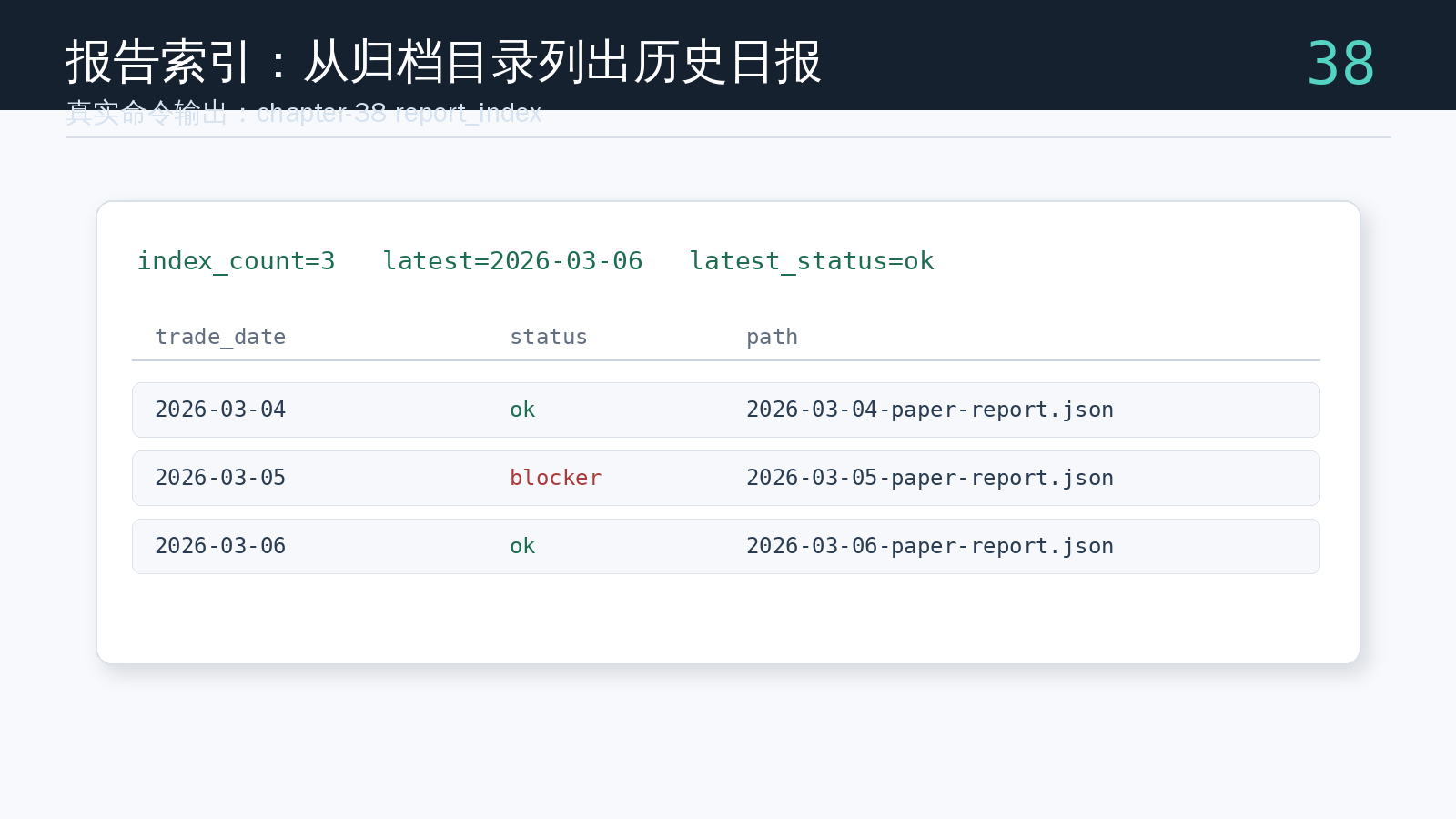
The index contains records for 2026-03-04, 2026-03-05, and 2026-03-06, with the middle day marked as blocker. The index does not read full report bodies. It keeps the minimum fields needed for list pages and debugging entry points.
Test Index Order
Run:
uv run pytest tests/test_report_index.py tests/test_report_archive.py tests/test_run_history.pyKey assertions:
assert [entry.trade_date for entry in entries] == ["2026-02-05", "2026-02-06"]
assert [entry.status for entry in entries] == ["ok", "blocker"]
assert latest_report_entry(entries) == entries[-1]
This proves the index can list archived reports in stable order and pick the latest entry.
Repository
This article adds:
app/report_index.py;ReportIndexEntry;- report-index generation from an archive directory;
latest_report_entry();paper-run-planlinked example, showing how three days of archive files become a queryable index;tests/test_report_index.py, covering index order and empty index.
Repository:
https://github.com/ax2/zi-quant-platformCode for this chapter:
git clone https://github.com/ax2/zi-quant-platform.git
cd zi-quant-platform
git checkout chapter-38
uv sync --extra dev
uv run pytest tests/test_report_index.py tests/test_report_archive.py tests/test_run_history.py
The article 38 commit is 6d848ce, and the tag is chapter-38.
Summary
Once daily report archives have an index, historical files are no longer loose JSON scattered in a directory.
Article 38 extracts trade date, status, and path into a lightweight list. The next article handles blocked results: after checks fail, the system should provide a clear remediation action instead of only saying that it failed.
Follow ZiCode on WeChat
If this post was useful, you can follow later updates on WeChat as well.

X / Twitter
Follow @ax2_zicode
Faster technical notes, short thoughts, and new-post alerts are posted on X.

More in this column
- Quant Trading for Programmers 42: Persist Daily Run Artifacts
- Quant Trading for Programmers 41: Summarize The Daily Run Plan
- Quant Trading for Programmers 40: Compose The Daily Run Plan
- Quant Trading for Programmers 39: Turn Failed Checks Into Actions
- Quant Trading for Programmers 37: Generate Daily Run Results
- Quant Trading for Programmers 36: Shape The Daily Run Request
- Quant Trading for Programmers 35: Generate An Operations Checklist
- Quant Trading for Programmers 34: Detect Market Data Gaps