
Quant Trading for Programmers 36: Shape The Daily Run Request
Quant Trading for Programmers 36: Shape The Daily Run Request
Article 35 combined the run window, historical summary, data gaps, and health report into an operations checklist.
Article 36 starts collecting scattered inputs into one daily run request. Later, whether the run is triggered by CLI, scheduled job, or API, it should first construct the same request object.
What The Request Needs
A daily run needs at least four kinds of input.
| Field | Purpose |
|---|---|
trade_date | The trading day for this run |
generated_at | Request generation time, useful for tracing |
required_symbols | Symbols whose prices must exist for this run |
dry_run | Whether this is rehearsal only, without real actions |
These fields could be passed separately, but scattered parameters make entry functions harder to test over time. The value of a request object is not complexity. It fixes the boundary.
Implement The Request Object
Article 36 adds app/run_request.py.
@dataclass(frozen=True)
class DailyRunRequest:
    trade_date: date
    generated_at: datetime
    required_symbols: tuple[str, ...]
    dry_run: bool = True
The default dry_run=True is deliberate. When a paper-trading system moves toward productionization, the default behavior should remain conservative.
Lightweight Cleanup During Construction
The request builder removes empty symbols, deduplicates values, and trims spaces.
symbols = tuple(
    symbol.strip()
    for symbol in dict.fromkeys(required_symbols)
    if symbol.strip()
)
It does not validate stock-code format. Format validation should live closer to the market-data or stock-universe module. The request object only turns the caller’s symbol list into stable input.
Current Linked Output
Articles 36-40 can now be run through the same command:
uv run python -m scripts.chapter_examples paper-run-planThis command constructs a daily run request, builds a report index, checks the run result, maps failure actions, and composes the daily run plan. The request-object part prints:
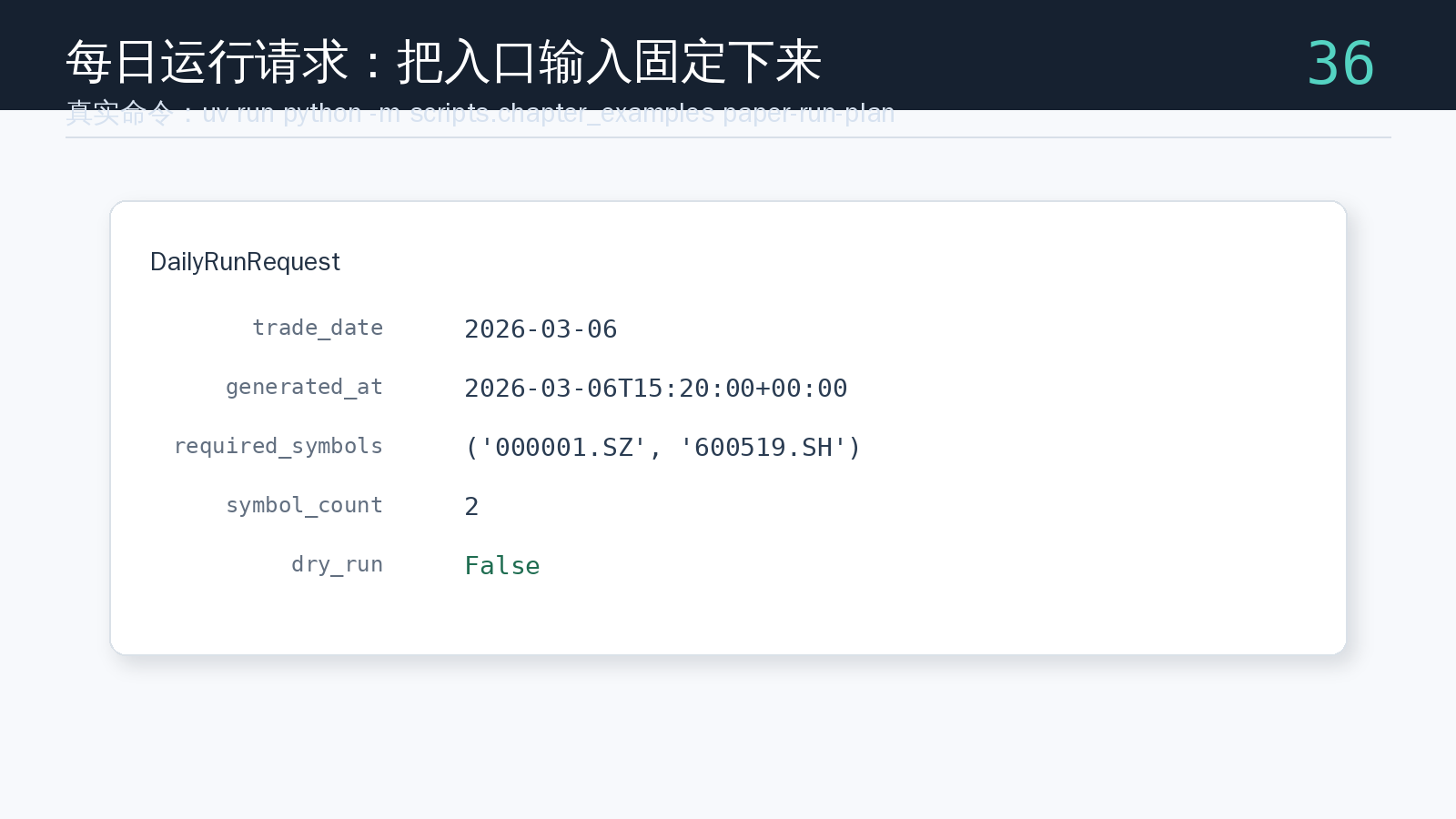
The sample passes duplicate 000001.SZ. The final request cleans required_symbols into ('000001.SZ', '600519.SH'). This looks small, but it ensures later price checks, data-gap checks, and log output all operate on one stable input.
Test The Request Boundary
Run:
uv run pytest tests/test_run_request.pyCore assertions:
assert request.required_symbols == ("000001.SZ", "600000.SH")
assert request.dry_run is False
assert request_symbol_count(request) == 2
Another test confirms that when dry_run is not passed, the default mode is rehearsal.
Repository
This article adds:
app/run_request.py;DailyRunRequest;build_daily_run_request(), which normalizes the required-symbol list;request_symbol_count(), useful for display and tests;- a linked
paper-run-planexample showing the request shape inside the full run plan; tests/test_run_request.py, covering deduplication, trimming, and default dry-run.
Repository:
https://github.com/ax2/zi-quant-platformCode for this chapter:
git clone https://github.com/ax2/zi-quant-platform.git
cd zi-quant-platform
git checkout chapter-36
uv sync --extra dev
uv run pytest tests/test_run_request.py
The article 36 commit is 5ec835f, and the tag is chapter-36.
Summary
The daily run request is the first foundation block for the later entry layer.
Article 36 collects trade date, generation time, required symbols, and dry-run flag into one object. The next article turns the operations checklist into a run result, making it clear whether this request is ready, dry-run-ready, or blocked.
Follow ZiCode on WeChat
If this post was useful, you can follow later updates on WeChat as well.

X / Twitter
Follow @ax2_zicode
Faster technical notes, short thoughts, and new-post alerts are posted on X.

More in this column
- Quant Trading for Programmers 40: Compose The Daily Run Plan
- Quant Trading for Programmers 39: Turn Failed Checks Into Actions
- Quant Trading for Programmers 38: Index Daily Report Archives
- Quant Trading for Programmers 37: Generate Daily Run Results
- Quant Trading for Programmers 35: Generate An Operations Checklist
- Quant Trading for Programmers 34: Detect Market Data Gaps
- Quant Trading for Programmers 33: Summarize Paper-Trading Run History
- Quant Trading for Programmers 32: Archive Daily Run Results As JSON