
Quant Trading for Programmers 40: Compose The Daily Run Plan
Quant Trading for Programmers 40: Compose The Daily Run Plan
Articles 36-39 added the daily run request, run result, archive index, and failure-action policy.
Article 40 combines these parts into a daily run plan. At this point, the system is no longer just a set of independent functions. It has the shape of a clear runtime entry point.
What The Run Plan Contains
DailyRunPlan groups four kinds of objects:
| Field | Source |
|---|---|
request | daily run request from article 36 |
result | run result from article 37 |
failure_actions | failure handling actions from article 39 |
action_summary | failure-action summary |
This is not the final trading executor, but it is already sufficient as a return object for a CLI or scheduled job.
Plan Object
Article 40 adds app/daily_run_plan.py.
@dataclass(frozen=True)
class DailyRunPlan:
    request: DailyRunRequest
    result: DailyRunResult
    failure_actions: tuple[FailureAction, ...]
    action_summary: str
The plan keeps request so debugging can see the original input. Do not keep only the result; otherwise many production issues lose context.
Compose The Plan
The composition logic reuses functions from the previous articles.
def build_daily_run_plan(*, request: DailyRunRequest, checklist: OpsChecklist) -> DailyRunPlan:
    result = build_daily_run_result(request=request, checklist=checklist)
    actions = build_failure_actions(result)
    return DailyRunPlan(
        request=request,
        result=result,
        failure_actions=actions,
        action_summary=failure_action_summary(actions),
    )
There is no duplicated checking logic here. The run plan orchestrates; it does not copy business rules.
When Can It Execute?
plan_can_execute() is stricter than result_is_actionable().
def plan_can_execute(plan: DailyRunPlan) -> bool:
    return plan.result.status == "ready"
dry_run_ready can keep generating reports, but it cannot perform real actions. It is actionable, but not executable.
Current Linked Output
Article 40 closes this command:
uv run python -m scripts.chapter_examples paper-run-planThe daily run plan is blocked by data_gaps:
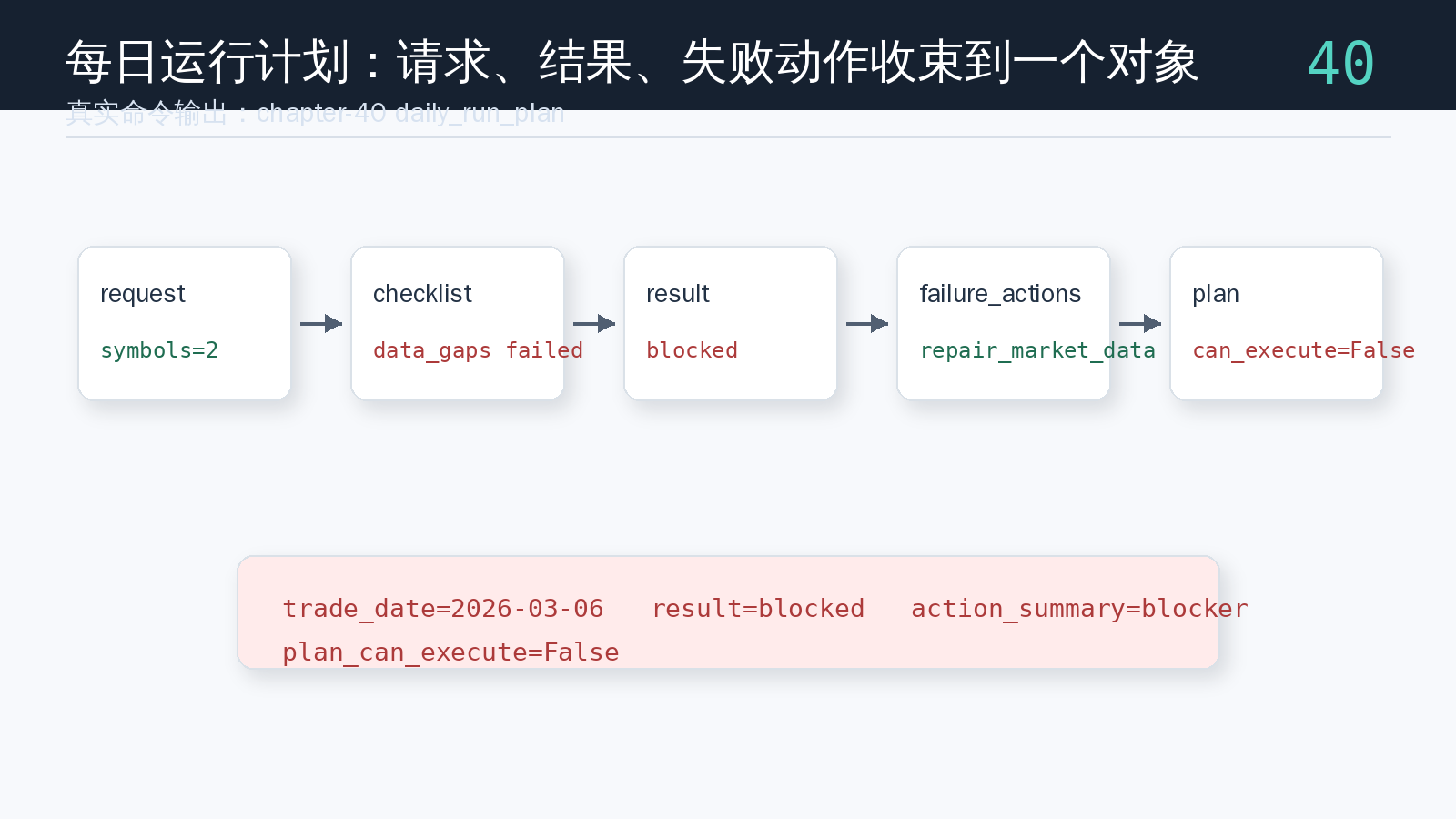
The key conclusion is can_execute=False. It means the current plan can be recorded, displayed, and archived, but must not enter the real execution phase. When a CLI or scheduler is added later, the entry layer can directly use this boolean to decide whether to continue.
Test Three Kinds Of Plans
Run the tests for this article:
uv run pytest tests/test_daily_run_plan.py tests/test_failure_policy.py tests/test_run_result.py tests/test_ops_checklist.py tests/test_run_request.pyThe tests cover:
- ready plan can execute and needs no failure actions;
- blocked plan returns actions such as
wait_next_windowandrepair_market_data; - dry-run-ready can continue observation, but
plan_can_execute()returns false.
The full suite also passed:
251 passed, 2 warningsRepository
This article adds:
app/daily_run_plan.py;DailyRunPlan;- composition of daily request, operations checklist, run result, and failure actions;
plan_can_execute();- linked
paper-run-planexample, showing how a blocked plan prevents real execution; - entry-layer semantics for actionable, executable, and
can_execute; tests/test_daily_run_plan.py, covering ready, blocked, and dry-run-ready;- stage review for articles 36-40.
Repository:
https://github.com/ax2/zi-quant-platformCode for this chapter:
git clone https://github.com/ax2/zi-quant-platform.git
cd zi-quant-platform
git checkout chapter-40
uv sync --extra dev
uv run pytest tests/test_daily_run_plan.py tests/test_failure_policy.py tests/test_run_result.py tests/test_ops_checklist.py tests/test_run_request.py
The article 40 commit is f19a07d, and the tag is chapter-40. The current full suite passes with 251 passed, with only existing FastAPI deprecation warnings.
Review Of Articles 36-40
The eighth group of five articles combines the scattered operations capabilities into a daily runtime entry point.
Article 36 adds the daily run request, collecting trade date, generation time, required symbols, and dry-run flag.
Article 37 adds the run result, converting the checklist into ready, dry_run_ready, or blocked.
Article 38 indexes daily report archives so historical reports can be listed and queried reliably.
Article 39 maps failed checks to handling actions, making blocked states operational.
Article 40 combines request, checklist, run result, and failure actions into a daily run plan.
This group continues directly from the previous one. Articles 31-35 added pre-run checks. Articles 36-40 organize those check results into the entry layer. When CLI or scheduled jobs are added later, there is no need to reinvent runtime state; they can wrap execution around DailyRunPlan.
The main branch also adds a cross-chapter command:
uv run python -m scripts.chapter_examples paper-run-planIt turns articles 36-40 into one runnable demo: construct a daily request, read the archive index, generate a blocked result, map failure actions, and compose the final daily run plan. The command deliberately keeps a missing market-data scenario to show how the plan object carries the no-go reason up to the entry layer.
Summary
The daily run plan is the first shape of a productionized paper-trading entry point.
After article 40, the system can split one run into input, checks, result, failure actions, and executable judgment. The next step is to connect this to a real command-line entry point so the daily paper-trading flow is driven by one shared plan object.
Follow ZiCode on WeChat
If this post was useful, you can follow later updates on WeChat as well.

X / Twitter
Follow @ax2_zicode
Faster technical notes, short thoughts, and new-post alerts are posted on X.

More in this column
- Quant Trading for Programmers 44: Execution Guard
- Quant Trading for Programmers 43: Command Response Object
- Quant Trading for Programmers 42: Persist Daily Run Artifacts
- Quant Trading for Programmers 41: Summarize The Daily Run Plan
- Quant Trading for Programmers 39: Turn Failed Checks Into Actions
- Quant Trading for Programmers 38: Index Daily Report Archives
- Quant Trading for Programmers 37: Generate Daily Run Results
- Quant Trading for Programmers 36: Shape The Daily Run Request