
2018: Short Video Rewrote Traffic
I am an old-school programmer. After leaving big tech I have spent my time in startups, and I am still doing hands-on AI-related development. This column will slowly trace the changes in IT from the 1990s to today, with some personal memories mixed in.
By 2018, short video was no longer a fresh feature. It was a new traffic structure.
In earlier years, when people talked about mobile internet, they talked about apps, social networking, feeds, and recommendation. By 2018, short video had compressed all of that into a higher-density machine for user time: the screen stood upright, content arrived automatically, and users only had to keep swiping.
For a social media platform like Weibo, that was heavy pressure.
Weibo had relationship chains, hot topics, celebrities, media, and public discussion. But short-video platforms used a different logic to compete for time: they did not require users to follow someone first or actively search for hot topics. They continuously used recommendation to test user interest.
Time Was Cut Into Smaller Pieces
The strongest part of short video was not only that the videos were short.
What it really changed was attention allocation.
In text-and-image feeds, users still scan titles, read comments, click into details, and jump back and forth. Short video has higher information density and faster feedback: within a few seconds, the user decides whether to keep watching or swipe away, and the system immediately receives feedback for the next item.
That feedback loop is extremely suitable for recommendation systems.
How long the user stayed, whether they replayed, liked, commented, followed the creator, swiped away, or watched to the end all become inputs to the next recommendation. The platform and the user form a high-frequency probing relationship.
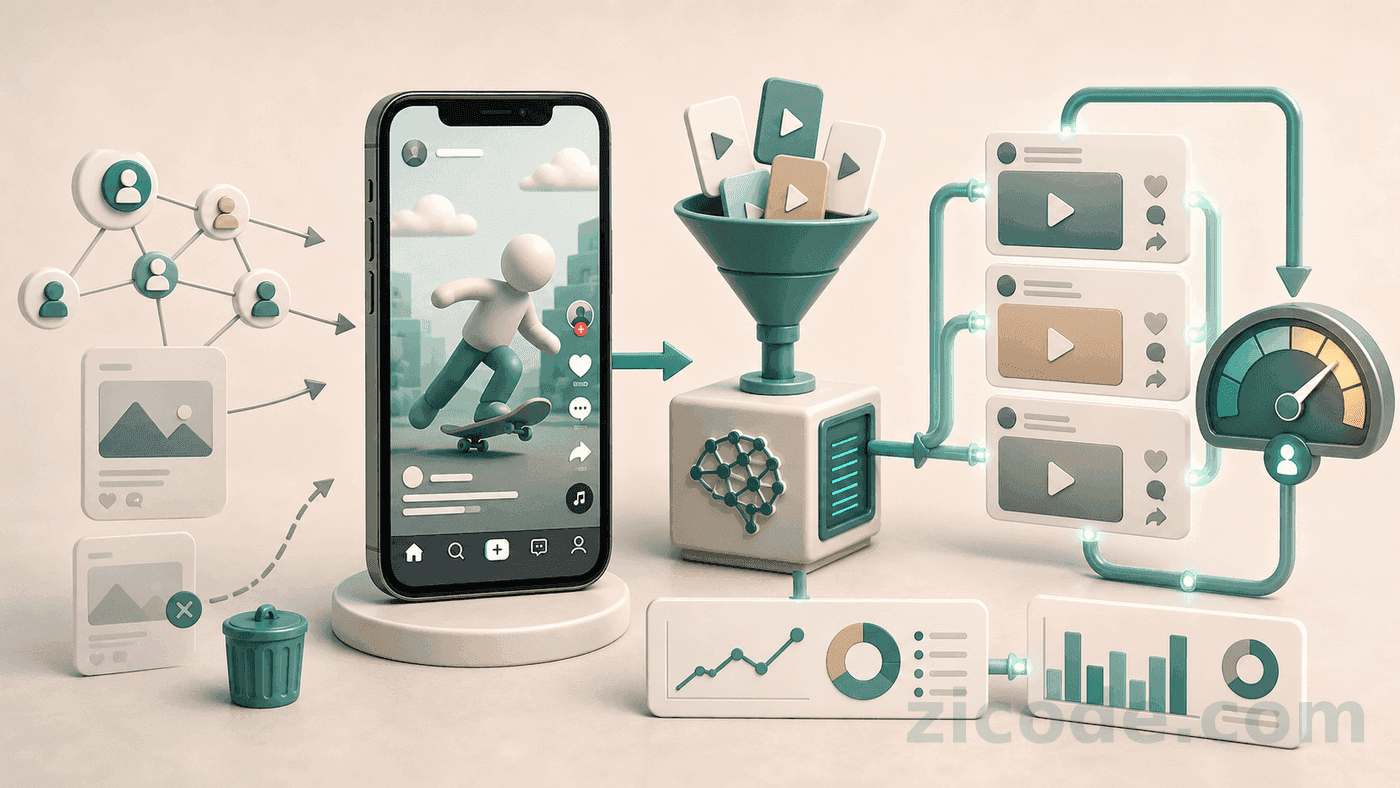
Weibo of course had recommendation, video, and feeds too. But when one platform’s genes are social and hot-topic based, while another platform’s genes are algorithmic distribution and immersive consumption, their organization, product goals, and technical priorities are different.
Recommendation Became The Entry Point Itself
In the past, recommendation systems were often modules inside products.
The home page had recommendation, detail pages had related items, ads had targeting, and operations had personalization strategies. Recommendation was important, but usually attached to an existing product structure.
Short-video platforms made recommendation the entry point itself.
When users open the app, what they see, what comes next, where they stay, and how the platform learns are all dominated by the recommendation system. The product structure becomes thin, while distribution logic becomes very heavy.
That raises requirements for backend and data platforms.
Recommendation needs content understanding, user profiles, real-time feedback, experiment platforms, effect evaluation, and strong engineering stability. A strategy change can directly affect a large amount of user time. You cannot only look at click-through rate; you also need retention, fatigue, content ecology, and long-term experience.
Weibo’s Advantages And Burdens
Weibo did have advantages.
It was strong in hot topics, public discussion, celebrities, and media supply. Those things could not be copied overnight by short-video platforms.
But advantages can also become burdens.
When a platform already has a mature business and a mature traffic structure, a new distribution method often struggles to receive top priority. You cannot simply move all resources into the new direction because the old business is still making money, old users are still there, and the old organization remains.
That is the hardest part of platform transformation.
It is not that people cannot see. It is that the system cannot move that fast. It is not that no one understands. It is that the whole system already has inertia.
What Engineers Could See
From an engineer’s point of view, the most memorable part of 2018 was this: product competition increasingly looked like system competition.
It was not one feature fighting another feature, or one page fighting another page. It was data, algorithms, content, clients, backend, operations, and organizational rhythm competing together.
Short video was powerful because it twisted user feedback, content supply, and recommendation distribution into a high-frequency loop. Once that loop starts spinning, latecomers can hardly catch up through a single capability.
Weibo of course still had its own position. Public events, hot-topic propagation, celebrity relationships, and media discussion remained important. But the underlying way user time was distributed had changed, and that change would affect many later years.
The next year, I would feel something else more strongly: platform companies do not necessarily fail to see the future. They just may not have enough courage to change themselves after seeing it.
IT Events Of 2018
- Short video continued rapid growth. Vertical immersive content consumption became an important mobile internet form. User time was redistributed by higher-frequency content feedback loops.
- Microsoft announced its acquisition of GitHub. The event showed that open-source collaboration and developer ecosystems had become core assets in cloud and enterprise software competition. Code hosting platforms were no longer just tool websites; they were developer entry points.
- BERT was open sourced. Google open sourced BERT, and the Transformer route began showing strong results in natural-language understanding. Pretrained models became an important direction in NLP.
- Recommendation became the entry point itself. Recommendation was no longer only a module inside products. It began dominating many content platforms’ home pages and user time. Distribution power continued moving from follow relationships and editorial choice toward algorithmic feedback.
- Feed competition escalated. Short video, social relationships, hot-topic propagation, and algorithmic recommendation competed more intensely for user time. Content-platform competition increasingly became a combined contest of data, algorithms, content supply, and organizational rhythm.
References
- ByteDance: Company history
- Weibo Corporation SEC Filings: Annual reports and IPO materials
- Microsoft: Microsoft to acquire GitHub
- Google Research Blog: Open Sourcing BERT
Follow ZiCode on WeChat
If this post was useful, you can follow later updates on WeChat as well.

X / Twitter
Follow @ax2_zicode
Faster technical notes, short thoughts, and new-post alerts are posted on X.