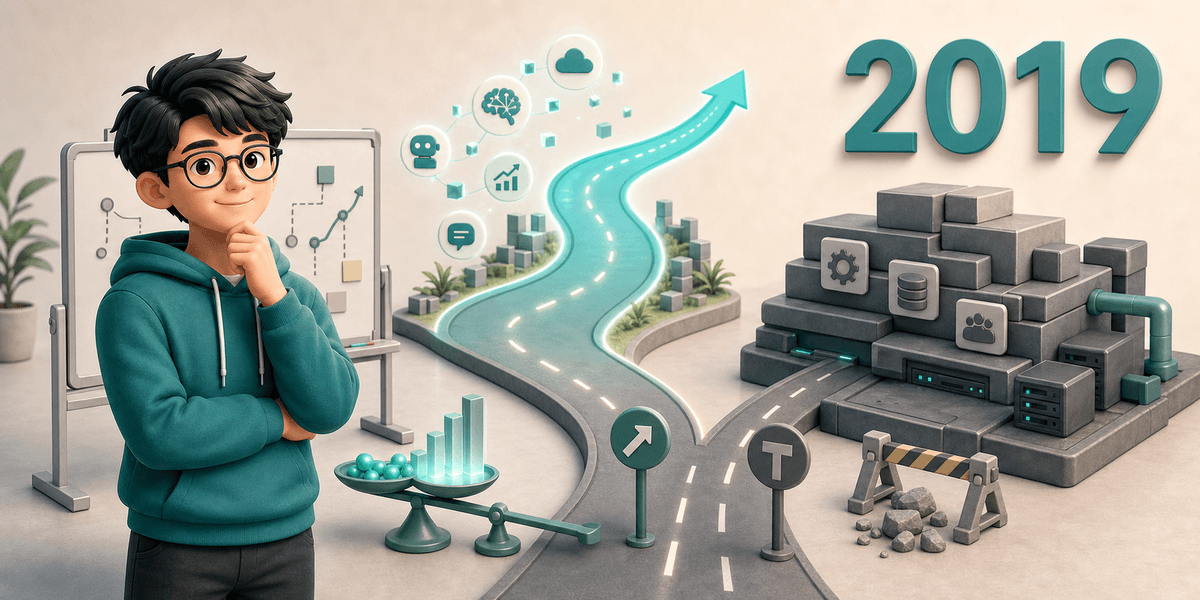
2019: Seeing The Future And Still Failing To Catch Up
I am an old-school programmer. After leaving big tech I have spent my time in startups, and I am still doing hands-on AI-related development. This column will slowly trace the changes in IT from the 1990s to today, with some personal memories mixed in.
By 2019, one judgment about platform companies became increasingly clear to me: many failures do not happen because the future was unseen, but because it was seen and still could not be caught.
That sentence is a little cruel.
From outside a company, people easily say a company is slow, conservative, or uninnovative. From inside, things are more complicated. Many directions had already been discussed internally. Many problems were not unmentioned. Many opportunities had been attempted.
The difficulty is investment.
Seeing A Direction Is Not Changing Resources
Platform companies have a natural contradiction: the stronger the old business, the harder the new direction.
Old businesses bring revenue, users, organizational structure, evaluation metrics, and mature processes. They attract resources and define internal standards of success. New directions are uncertain, have ugly short-term metrics, unclear organizational boundaries, and may even attack the old business.
So many companies build new projects, but do not truly bet their lives on them.
That is what I learned from the Weibo Toutiao experience. The company saw recommendation feeds, listed the project as high priority, and even reported weekly to the CEO. But compared with a company organized around recommendation distribution from day one, the resource investment and organizational determination were still not in the same league.

Looking back in 2019, that gap was already very clear.
Organizational Inertia Is Not Only A Bad Word
“Inertia” sounds negative, but it is also why a company can run stably.
Without inertia, a company cannot keep delivering. Existing systems, teams, processes, and revenue models allow a platform to serve large numbers of users every day. Those things are valuable.
The problem is that when the external environment changes too quickly, inertia becomes resistance.
If a new opportunity extends the old business, platform companies often do well. If it requires changing distribution logic, organizational structure, resource allocation, or even value judgment, it becomes very hard.
Short video and algorithmic recommendation were changes of that level for Weibo.
It was not as simple as “add a video channel,” nor as simple as “improve the recommendation algorithm.” It required the platform to re-understand content, users, and distribution power.
Engineering Systems Also Have Inertia
Organizations have inertia, and technical systems have inertia too.
A platform running for many years carries backend services, databases, caches, logs, data warehouses, client protocols, operations tools, moderation systems, and experiment platforms with historical baggage.
If a new project starts completely from scratch, it may move fast but lose existing platform capabilities. If it reuses old systems, it is constrained by them.
Engineers often suffer in that scene.
You know what the ideal architecture is, and you also know why the real system cannot immediately become that architecture. You must trade off business windows, team resources, online stability, and technical debt.
Many external comments reduce missed platform opportunities to “bad strategy.” Strategy matters, of course. But when strategy reaches the engineering site, it often becomes dozens of systems, hundreds of APIs, countless historical data paths, and long-term organizational collaboration.
The Hardest Part Is Admitting The Battlefield Changed
For a platform company, the hardest thing is not building a new product. It is admitting that the main battlefield has changed.
If the battlefield is still social relationships and hot-topic propagation, Weibo is strong. If the battlefield becomes algorithmic content-consumption time, Weibo must compete with another set of capabilities.
Admitting the battlefield changed means reallocating resources, and it also means past advantages are no longer enough.
That is hard.
An individual finds it hard to deny their own path to success. A company is the same. The more successful a company is, the easier it is to believe past logic will keep extending.
In 2019, I increasingly felt I was standing in the later half of a platform’s life. It was still important, still valuable, and still profitable, but the strongest new traffic was already forming elsewhere.
The next year, the pandemic would change everyone’s way of working. Remote work, slower growth, and cost pressure would appear more and more often.
IT Events Of 2019
- Short video and algorithmic recommendation kept expanding. User time moved further toward new content forms. Platform competition depended not only on content quantity, but also distribution efficiency, feedback speed, and content ecology.
- Huawei was added to the Entity List. In 2019, Huawei was added to the U.S. Department of Commerce Entity List. Technology supply chains, chips, operating systems, and communication equipment entered public narratives of international technology competition more directly.
- Platform companies faced tests from new entry points. When new entry points appear, mature platforms need not only technical judgment, but organizational determination and resource investment. The stronger the existing business, the harder the turn.
- Technical debt affected strategic speed. Historical systems, organizational boundaries, data pipelines, and existing revenue models inside large internet companies affected new-business progress. Strategy ultimately lands on engineering systems and organizational collaboration.
- Efficiency became a clearer theme. As growth slowed, platform companies more often focused on ROI, organizational efficiency, and resource allocation. The internet industry gradually moved from an expansion narrative into an efficiency narrative.
References
- Weibo Corporation SEC Filings: Annual reports and company filings
- ByteDance: Company history
- Federal Register: Addition of Entities to the Entity List
Follow ZiCode on WeChat
If this post was useful, you can follow later updates on WeChat as well.

X / Twitter
Follow @ax2_zicode
Faster technical notes, short thoughts, and new-post alerts are posted on X.