Tag: #Python

50 posts

2004: Languages Became a Toolbox
Essays · Views

2004: Languages Became a Toolbox

The ninth essay in Thirty Years in IT and Me. In 2004, Gmail, Firefox, Ubuntu, Facebook, Google's IPO, and MapReduce pushed the internet into a more complex stage. Inside a Linux company, Perl, PHP, Java, Shell, and early Python felt less like beliefs and more like tools within reach.


What Programmers Need to Learn Before Building a Quant Platform
Quant Trading · Views

What Programmers Need to Learn Before Building a Quant Platform

This is not about secret indicators. It is a practical knowledge map for programmers who want to build a quant-trading platform: data, factors, strategies, backtesting, risk controls, execution, performance, quality, and the long path from research to real results.

Quant Trading for Programmers: Column Roadmap
Quant Trading · Views

Quant Trading for Programmers: Column Roadmap

A practical engineering roadmap for building a quant-trading platform around a real GitHub project: Python project structure, A-share rules, data layers, factors, backtesting, paper trading, alerts, daily runs, and operations.

Quant Trading for Programmers 44: Execution Guard
Quant Trading · Views

Quant Trading for Programmers 44: Execution Guard

Article 44 adds ExecutionDecision, centralizing the execution judgment for ready, dry-run-ready, and blocked states so the command layer cannot accidentally trigger real paper-trading side effects.

Private PyPI With pypiserver And uv
Engineering · Views

Private PyPI With pypiserver And uv

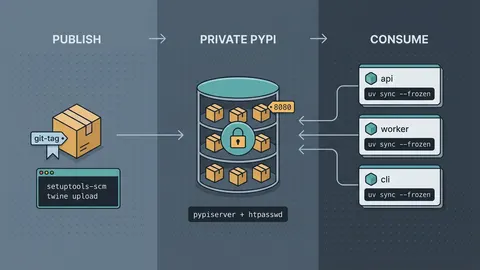
A practical internal package workflow using pypiserver and uv: authentication, PEP 440 versioning, setuptools-scm, Docker without git, uv project configuration, BuildKit secrets, and CI publishing pitfalls.

Large-Scale LLM Classification: From Brute Force To Tree Pruning
Engineering · Views

Large-Scale LLM Classification: From Brute Force To Tree Pruning

When thousands of entities need to be labeled by an LLM, the naive approach can be shockingly expensive. This article breaks down reusable optimizations: hierarchical pruning, inheritance, batching, incremental skipping, ancestor expansion, prompt caching, and asyncio orchestration.